

The sports world loves a big number.
When a superstar signs a massive contract in the prime of their career, it dominates headlines and gets fans buzzing. The hobby isn’t immune to that excitement, either. Collectors talk themselves into “this deal will change everything,” and for a moment, it feels like a rocket is about to launch.
But does the ink on a mega contract actually move card prices? Or are we chasing smoke? Let’s dig into three modern baseball case studies — Juan Soto, Shohei Ohtani, and Bryce Harper — to see if free agency hype is worth flipping into.
*Since we’re looking at comps from years ago, we used ALT.xyz’s recent auction transactions instead of our go-to, 130pt*
Juan Soto: The $765 Million Met
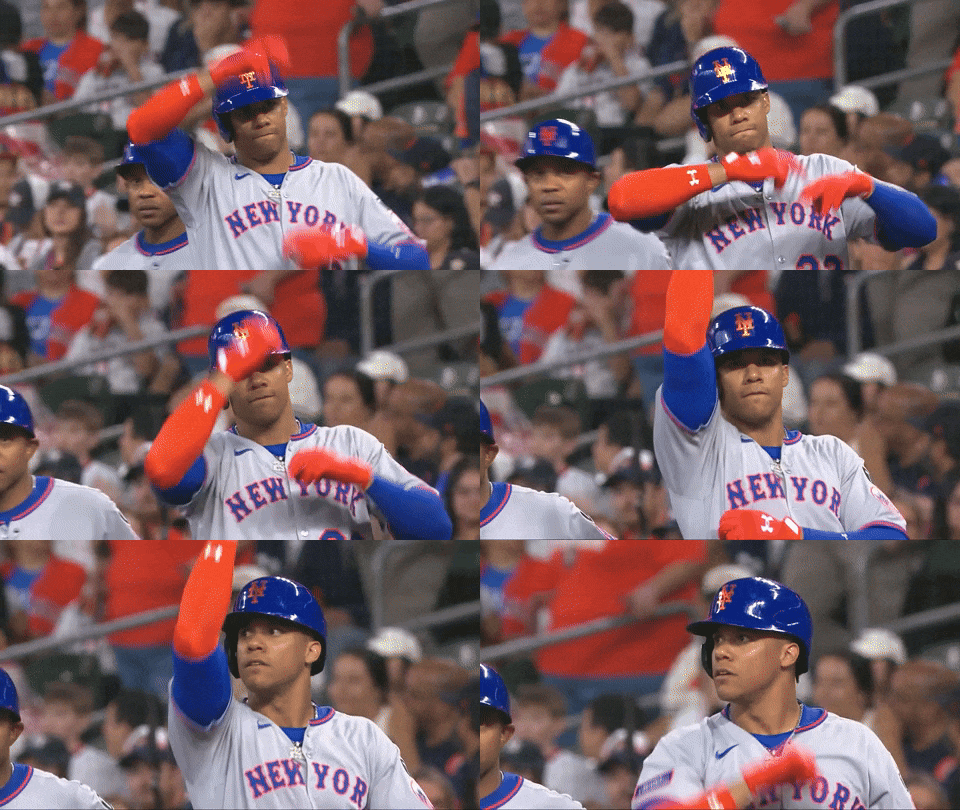
In 2024, Soto’s impending free agency with the Yankees was all anyone could talk about. A bidding war was inevitable. Would he stay in the pinstripes long-term? Or would Steve Cohen throw Mets money at him? What about the Blue Jays?
Here’s how his 2018 Topps Chrome Update Refractor performed during this time:
April–May: $2547 avg
June–July: $1960 avg
Aug–Sept: $1932 avg
Offseason before signing: $1621 avg
Offseason after signing with Mets for $765M: $1922 avg
That’s a clear slide all year long, with only a modest rebound after the deal. If you bought during the season expecting the contract to send prices soaring, you were left holding the bag.
Shohei Ohtani: Free Agency’s Unicorn
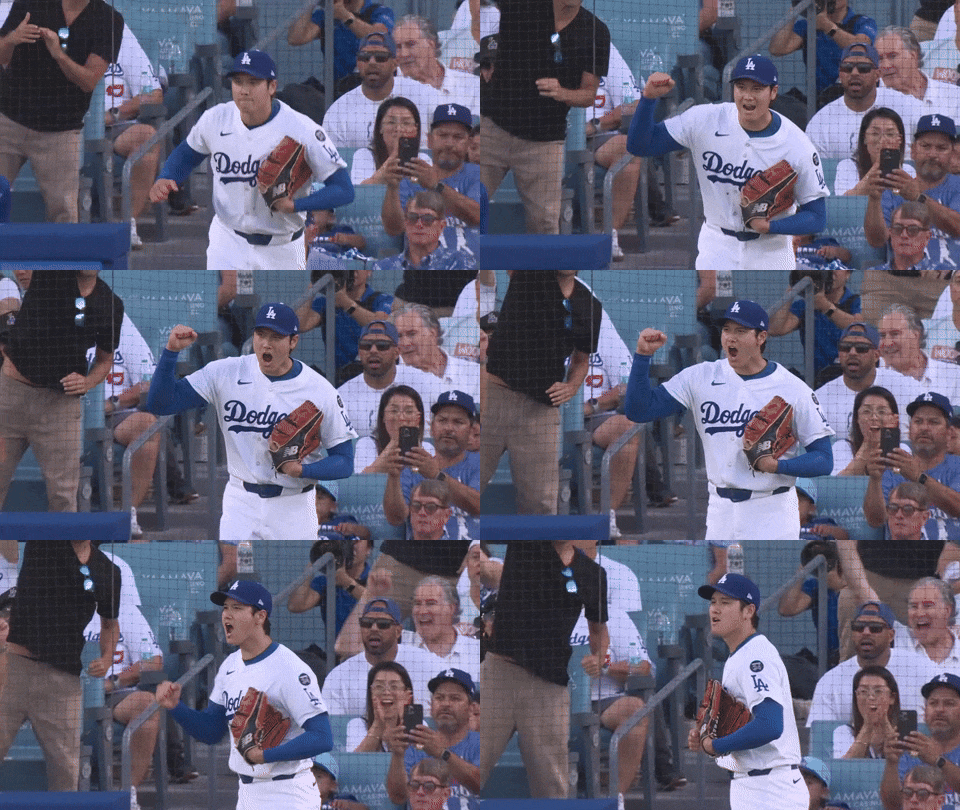
Ohtani’s free agency in 2023 wasn’t just a storyline — it was the storyline. Nobody could even comprehend how high his price tag would go. And in the hobby, everyone wanted in.
His 2018 Topps Chrome Update Refractor looked like this:
April–May: $1725 avg
June–July: $2433 avg (peak)
Aug–Sept: $2250 avg
Offseason before signing with Dodgers: $1585 avg
After signing: $1650 avg
The hype was strongest in the middle of the season, when rumors ran wild. But once he actually signed with the Dodgers, prices had cooled off. The contract itself? It barely moved the needle.
⚠️ Important note: Ohtani’s offseason dip was also compounded by Tommy John surgery, which likely exaggerated the price drop.
Bryce Harper: The Outlier in Philly
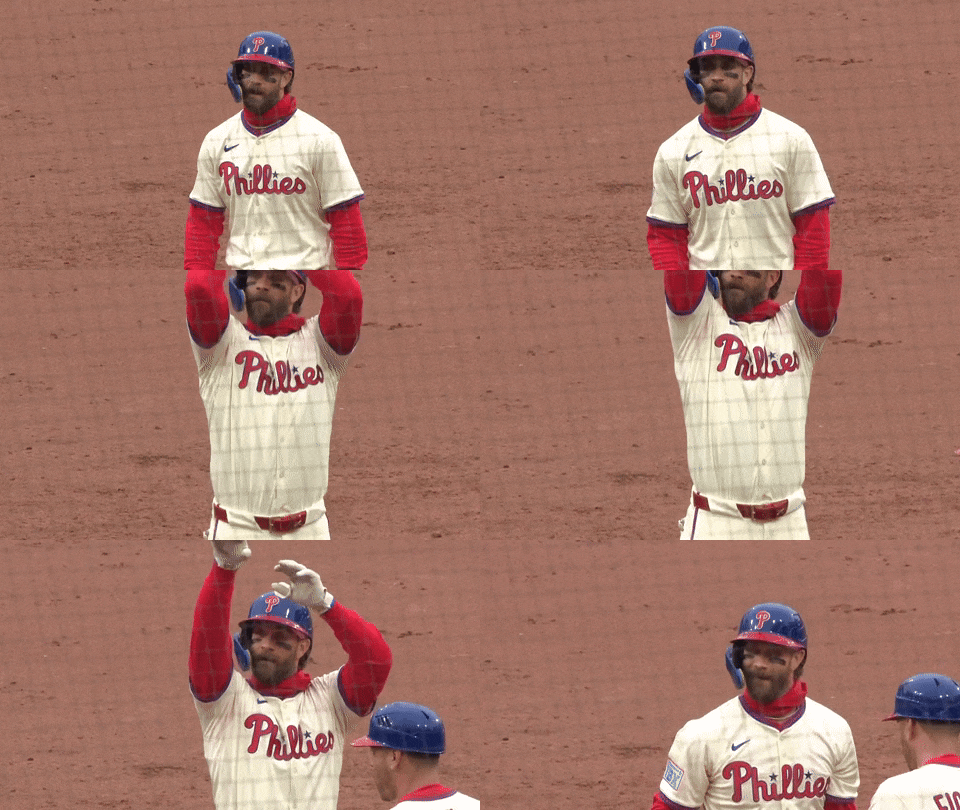
Harper’s free agency back in 2019 was just as big a story as Soto’s or Ohtani’s. But unlike those other megastar deals, Harper’s narrative had a surprise twist: Philadelphia was never the front-runner. Collectors were watching a bidding war unfold, and everyone assumed he’d land somewhere else.
Here’s how his Chrome Rookie Refractor performed leading into the deal (keep in mind this was before the pandemic-powered sports card boom, so numbers look modest by today’s standards):
April–May: $148 avg
June–July: $86 avg (slump)
Aug–Sept: $135 avg
Offseason before signing: $130 avg
Offseason after signing $330M deal with Phillies: $239 avg
Here’s where it gets interesting: Harper did see a major bump after his signing. The surprising move to Philadelphia gave him a new fan base, a fresh narrative, and for the first time in years, real momentum in the hobby.
Reading the Pattern
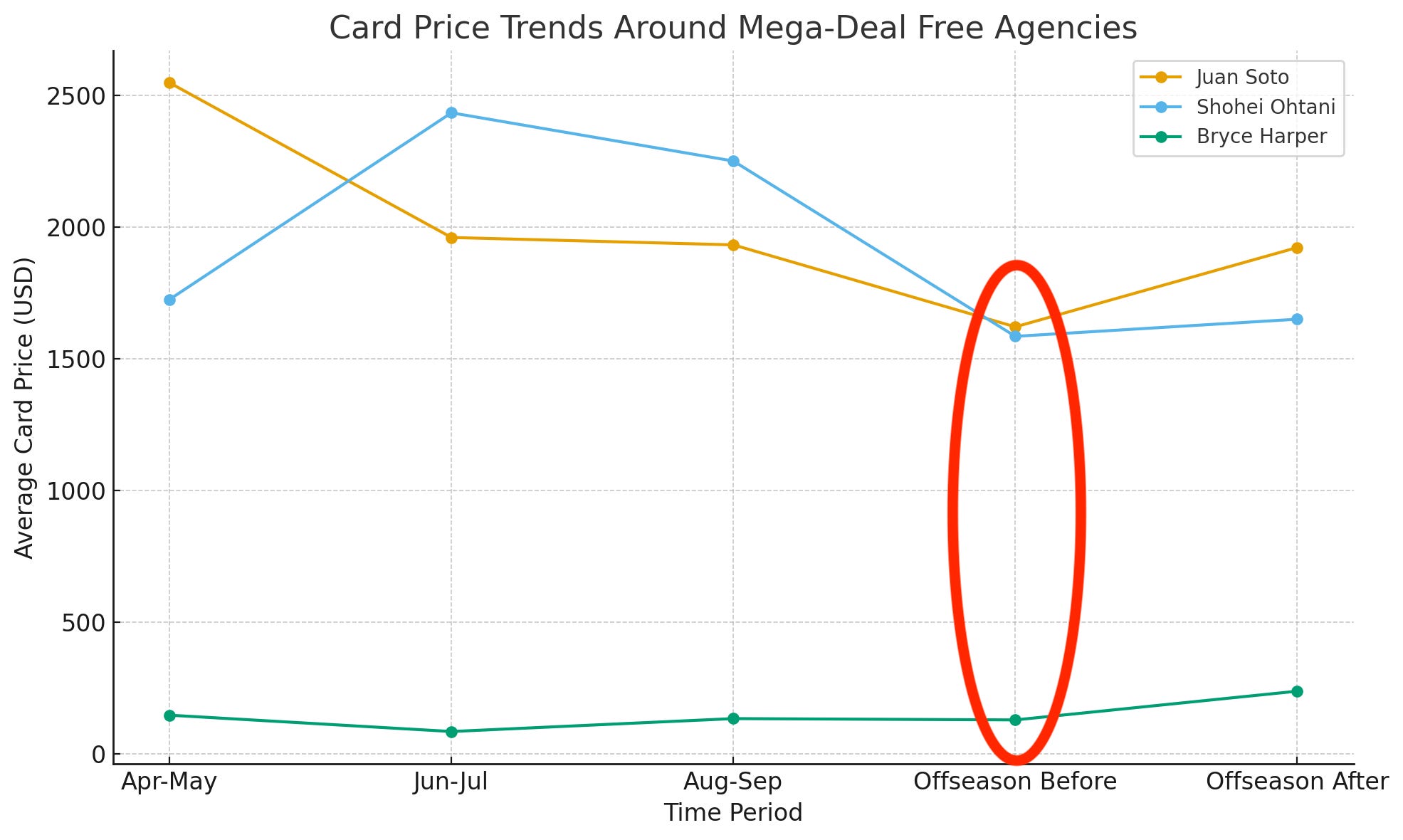
Looking at these three, we can pull a few threads:
The deal is already priced in. For Soto and Ohtani, the market anticipated the mega contract, and by the time it happened, there wasn’t much left to gain.
The peak is in the rumors. Mid-season, when speculation is hot, prices are at their highest.
The pre-signing dip is real. Across all three, the months before the contract showed a noticeable soft spot.
Harper’s case was the exception, not the rule. His post-signing bump had more to do with a surprising fresh start in Philly than the dollar figure itself.
Our Takeaway
If you’re trying to flip, don’t expect the signature alone to do the heavy lifting. By the time a contract is official, the market has already moved.
Buy in the lull: In the offseason just before a deal is announced. The cleanest entry point is when the season is over — the hype cools and casual buyers can get distracted.
Sell into the noise: The sweet spot is actually mid-season, when rumors swirl and ESPN headlines are doing the marketing for you.
Don’t chase the ink: Unless the deal completely changes the narrative (like Harper to Philly), mega contracts are more confirmation than catalyst.
For collectors, this is actually good news: if you want to stash a superstar PC card, those pre-signing months are often the best window you’ll get.
Because in the hobby, it’s not the contract that matters — it’s the anticipation of it.
Disclaimer: The content in The Hobby Wire is for informational and entertainment purposes only. Commentary, analysis, and opinions on sports cards, rookies, and the hobby are not financial, investment, or professional advice. Collectors should always do their own research before buying, selling, or trading cards. Market values are volatile and can change rapidly—past performance is not a guarantee of future results.
Unless specified, all pricing references are based on the Prizm/Refractor parallels of an athlete's Chrome rookie card, with prices from 130pt.com.
Any odds mentioned were derived from DraftKings Sportsbook.