

Last month, one of our deep dives reminded us that baseball collectors value consistency and individual accolades far more than wins. But what happens when a player quietly checks every box—and still feels underrated in the hobby?
In this series, we usually spotlight athletes with runway to spare. But sometimes the hobby sleeps on the steady veterans—so let’s flip the script.
For 16 seasons, Freddie Freeman has been the sport’s north star of consistency: nine All-Star nods, a Gold Glove, three Silver Sluggers, an MVP, and now three rings. Yet in a landscape dominated by Shohei, Skenes, and Judge, it’s fair to ask—does the hobby actually appreciate him?
The Book on Freddie
1B / Los Angeles Dodgers / Draft Info: Round 2, Pick 14 in 2007
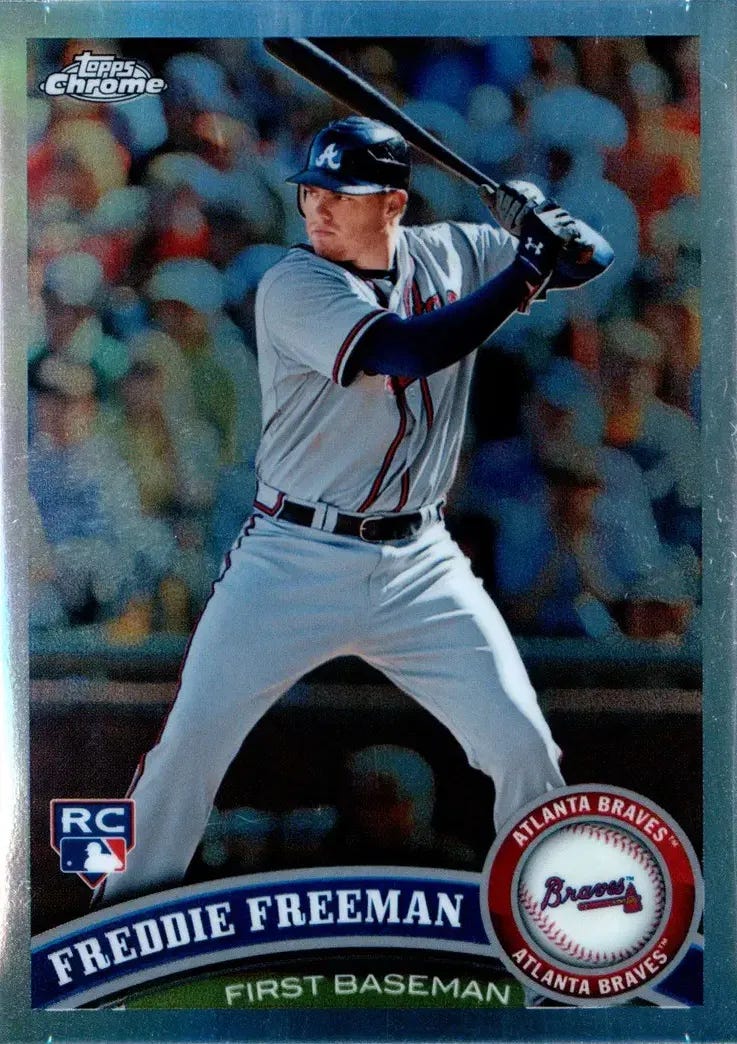
Few hitters embody consistency quite like Freddie Freeman. The Dodgers’ first baseman blends old-school plate discipline with modern power mechanics, making him one of the game’s purest left-handed bats. Freeman’s smooth, level swing generates effortless line drives to all fields, and his ability to adjust mid-at bat makes him a nightmare for pitchers who rely on sequencing. He’s a plus defender at first with soft hands and exceptional footwork, giving L.A. infielders the confidence to let it rip.
If there’s a knock, it’s the age-related decline in speed and baserunning value and that he still rolls over premium velocity on the inner half.
But Freeman’s blend of contact, power, and leadership remains the blueprint for a franchise cornerstone—and a model of longevity in an era built on volatility.
Do The Dodgers Help or Hurt?
Collectors know the hobby punishes great players in bad situations. Context matters. When we evaluate the ecosystem around a star, we’re looking at three things:
Coaching stability: Is there a system to grow in, or constant turnover?
Front office / ownership: Are they building winners, or making questionable moves?
Roster outlook: Is the supporting cast strong, or still in flux?
There really isn’t much of a debate. Whether you like their methods or not, the Dodgers, time and time again, put a winning team in front of us. They have one of the longest-tenured active managers in baseball with Dave Roberts and have made the postseason every year since 2013.
After winning it all in 2020, the front office got a taste and has made it their mission to collect as many rings as possible no matter the expense. They operate more like the early-2000s Yankees, and small-market fans absolutely hate it. Every winter, another star seems to board the next flight to LAX.
For more than two thirds of the league, Freddie Freeman would be the best player on the team. Instead, he gets to play with Mookie Betts, Shohei Ohtani, and whoever else they spend big bucks to get this offseason.
GOAT Watch 🐐
At The Hobby Wire, we’ve never understood why unproven talent commands higher prices than the true legends of a sport. If a modern rookie auto is outselling the GOAT at their position, that should be your signal to cash out. Let’s see how Freddie performs up against the greatest first basemen of the modern era, Albert Pujols.
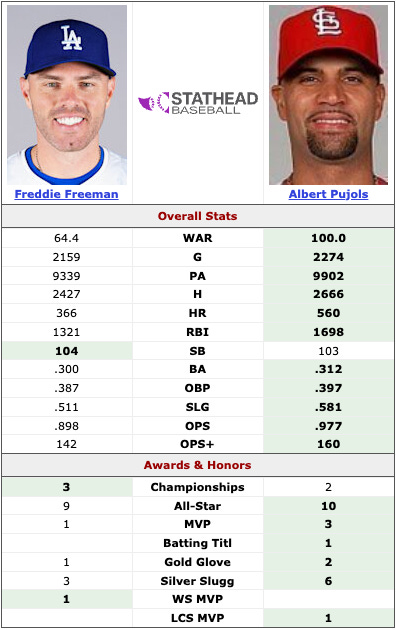
It’s easy to forget just how absurd peak Pujols was. Freeman isn’t Pujols—almost nobody is—but outside of raw slug totals, his career arc is closer than the hobby typically acknowledges.
Career Projection
Freddie Freeman has already played a full career. At 36 years old, and a body that’s starting to break down, it’s unlikely he plays deep into his 40s. His contract with the Dodgers is up after the 2027 season, this will either be where Freddie decides to hang up the cleats or find a new team where he can transition to more of a DH role (Maybe an Atlanta return? 👀)
We’re going to look at where his stats will be once his Dodgers contract expires and if he can skirt by to play into his 40s.
*Based on Freddie Freeman’s performance through the 2025 MLB Season.
16 Years (Current Stats)
WAR 64.2 • Hits 2,431 • HR 367 • RBI 1,322 • SB 104
18 Years (End of Dodgers Contract)
WAR 72.2 • Hits 2,734 • HR 413 • RBI 1,487 • SB 117
20 Years (Age 40)
WAR 80.3 • Hits 3,039 • HR 459 • RBI 1,653 • SB 130
He’s not catching Rose, Bonds, or Aaron. But four more years of typical Freddie production could put him within striking distance of becoming baseball’s 34th member of the 3,000-hit club—and that milestone still moves markets.
Hobby Heat Map
Here, we want to put our finger on the pulse of the hobby and get a sense on what collectors feel about Freeman. To do this, we’re going to take a low end rookie and a high end rookie and track sales performance throughout the last six years.
Our Low-End Pick: 2011 Topps Chrome #173 Freddie Freeman Base Card PSA 10
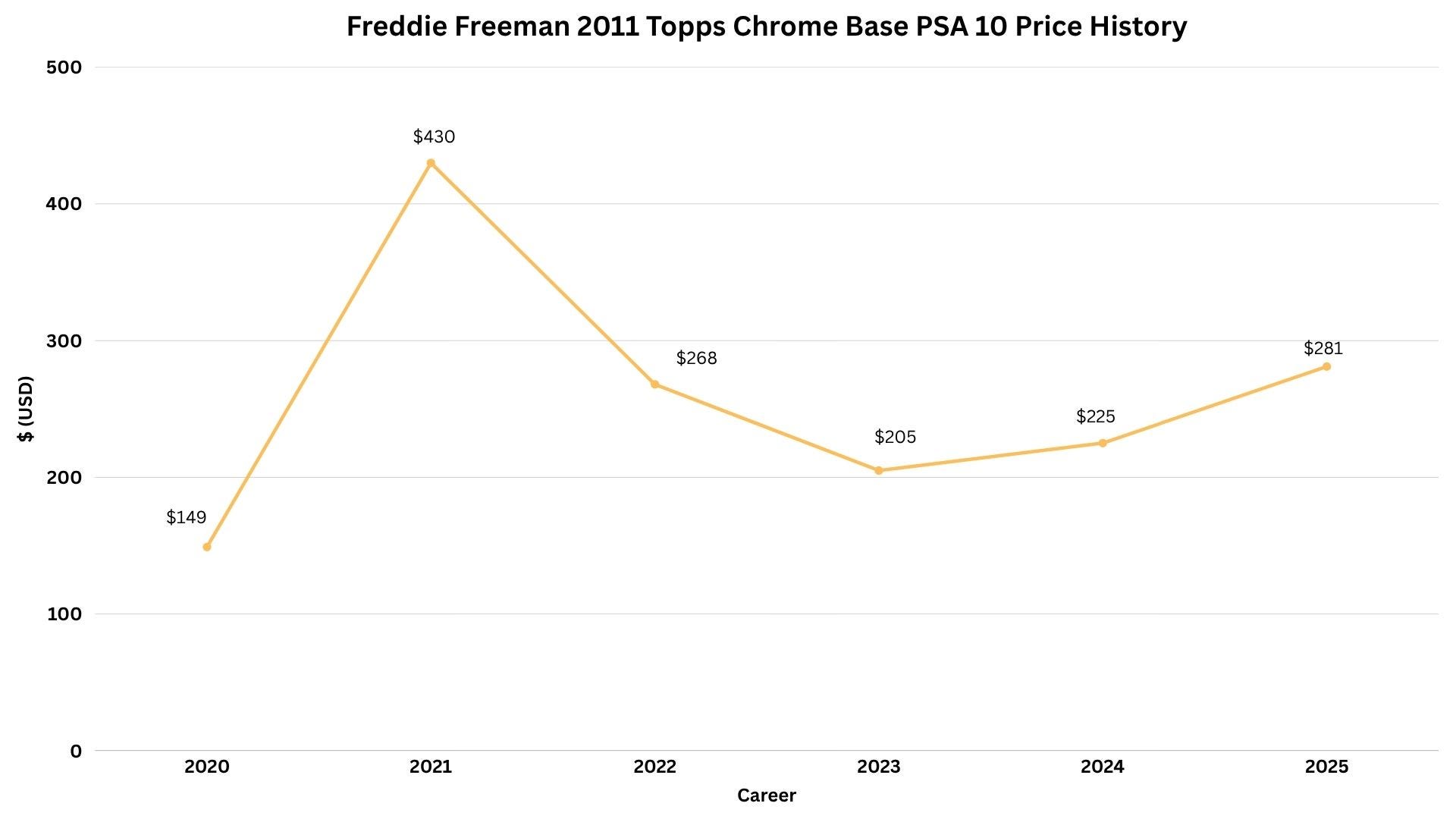
Freddie Freeman’s base Topps Chrome Rookie has had its ups and downs. A 2020 MVP Season + Stimulus Checks catapulted this card to an average of $430 in the 2021 season. Like with other cards we’ve looked at in 2021, the market has corrected. But there has been a slow but steady rise in his cards since 2023, where he placed 3rd in MVP voting. A couple of rings later, and his card price has risen 37%. Will this be the same with the high-end market?
Our High-End Pick:
2009 Bowman Chrome Freddie Freeman Prospect Auto #BCP101 PSA 10
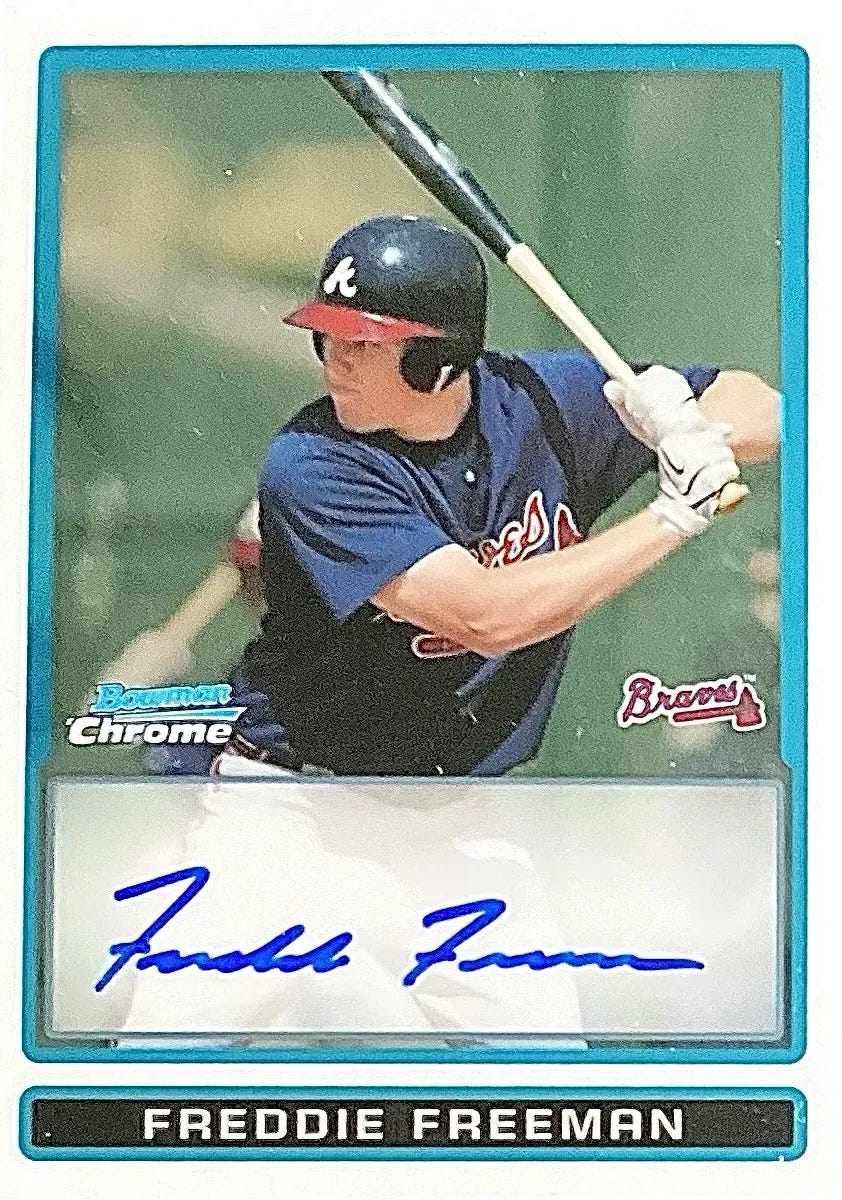
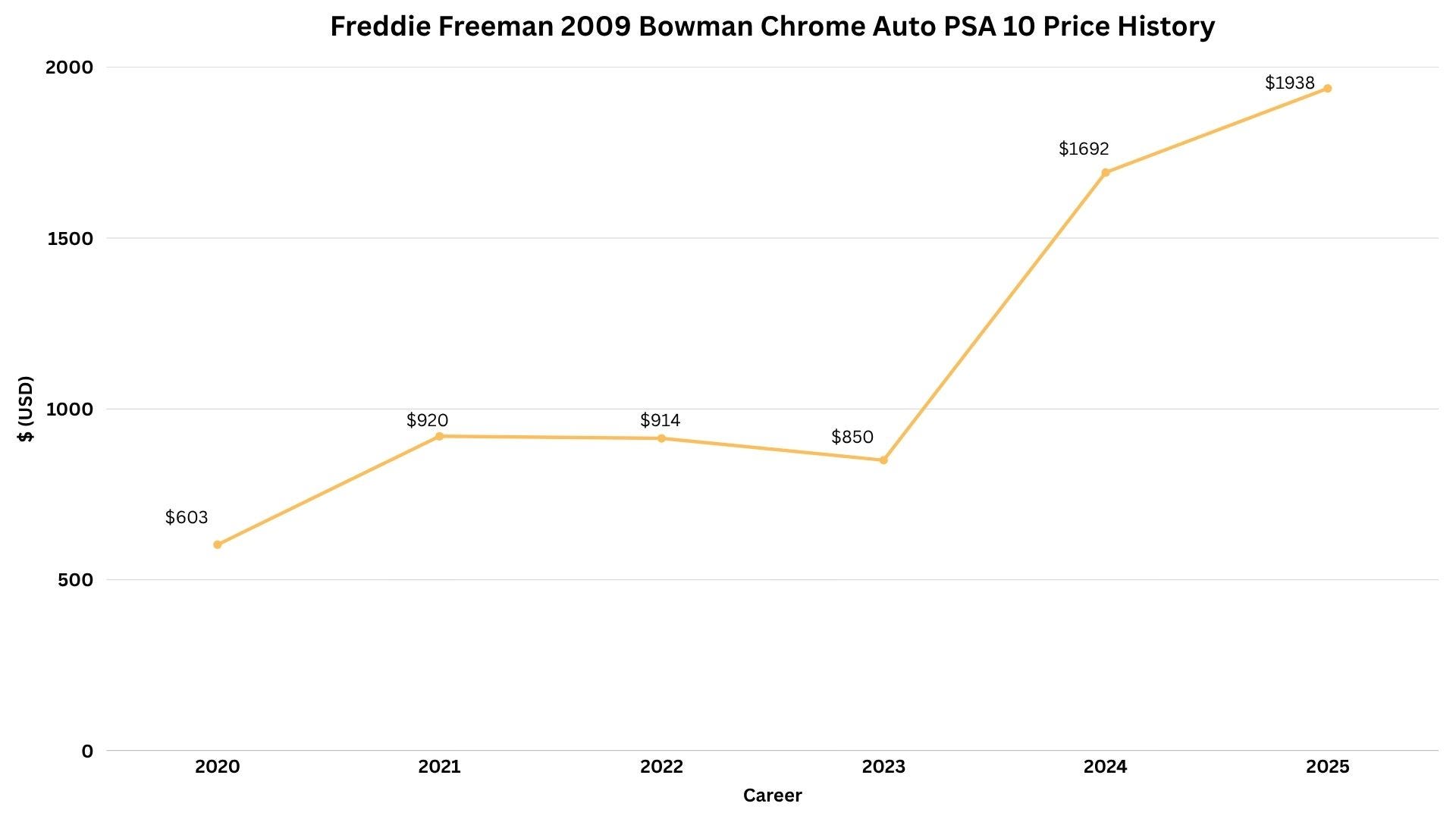
For the first time in this series, the high-end market isn’t mirroring the low-end trendline. We see a similar rise and correction from 2020-2023. But in 2024, specifically after Freeman’s historic World Series MVP performance, his card prices went vertical.
Investors with deeper pockets appear to be waking up.
What’s His True Value?
Let’s assume Freddie can play until he’s 40 and average the 150 hits per year he needs to reach the 3,000 hit club.
When he hangs up his cleats, he’ll have wrapped up a career not unlike recent Hall of Famer, and former Dodger, Adrian Beltre.
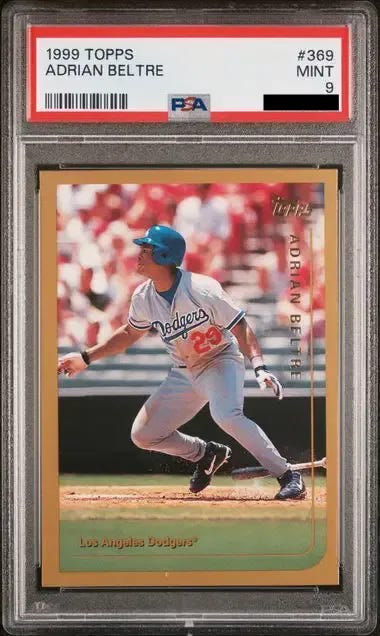
Adrian Beltre’s 1999 Topps Flagship Rookie Card currently sells for for $35 in a PSA 10. Freddie Freeman’s goes for $118.40. However, while there are only 37 copies of Beltre’s PSA 10, there are 3,329 copies of Freddie!

When you factor in the much larger pop, the true long-term value of Freddie Freeman’s base card is going to be closer to $0.38. Not great.
This doesn’t cover the whole story though. Freeman is far more decorated than Beltre—an MVP, multiple rings, and a more complete prime. Those accolades may allow his long-term hobby floor to sit higher than the raw supply data suggests.
Our Verdict
Even with the long-term pop concerns, Freeman looks like a near-term buy.
Why?
A few months from now, when the Dodgers’ World Series euphoria fades and the hobby pivots to the next wave of prospects, Freeman’s prices should soften. That dip could be the entry point for a long-term hold.
Sports media hasn’t seriously started the “3,000 hit” conversation yet. When it does—and it will—the hype cycle alone could send his market surging.
Buy the dip. Hold close to the milestone. Watch the hobby catch up to the player.
Disclaimer: The content in The Hobby Wire is for informational and entertainment purposes only. Commentary, analysis, and opinions on sports cards, rookies, and the hobby are not financial, investment, or professional advice. Collectors should always do their own research before buying, selling, or trading cards. Market values are volatile and can change rapidly—past performance is not a guarantee of future results.
Unless specified, all pricing references are based on the Prizm/Refractor parallels of an athlete’s Chrome rookie card, with prices from alt.xyz & 130pt.com.
Any odds mentioned were derived from DraftKings Sportsbook.