

If you keep your ear to the ground in this hobby, you’ve definitely heard these before. Print runs are out of control. Too many parallels. We’re heading for another junk wax era.
If we’re being honest, we don’t think we’re heading anywhere. We think we’re already standing in the middle of it.
But here’s what nobody grumbling about it bothers to do. Look back. The hobby has been right here before, almost beat for beat, and it left a paper trail. So that’s the plan today. We walk back through the eras, pull out what held value in each one and why, then use it to guess what survives the mess we’re in now.
Been around a while? This is the stuff you probably already feel in your gut, with the receipts attached. New here? Think of it as a map. Either way, you’ll come out able to size up any release, vintage or brand new, and know what’s worth keeping.
Let’s rip in.
Pre-War (1860s–1940s)

Back at the start, this wasn’t really collecting at all.
Tobacco and candy companies slipped cards into their products to move boxes off the shelf. The cards were advertising, not keepsakes. Nobody saved them. They were the prize at the bottom of the box, except the prize was a ballplayer.
The one you’ve heard of is the T206 Honus Wagner, the most famous piece of cardboard on earth, with sales in the millions. Part of the legend: Wagner reportedly didn’t want his face selling cigarettes and made the company pull his card. Only a fraction ever reached circulation.
That’s the whole era in miniature. Almost nothing survived, so what did, especially the legends, holds value in just about any condition. It’s also almost entirely baseball. The other sports were barely on cardboard yet. When supply is this tiny and frozen forever, just existing is enough.
Golden Era (1948–1985)
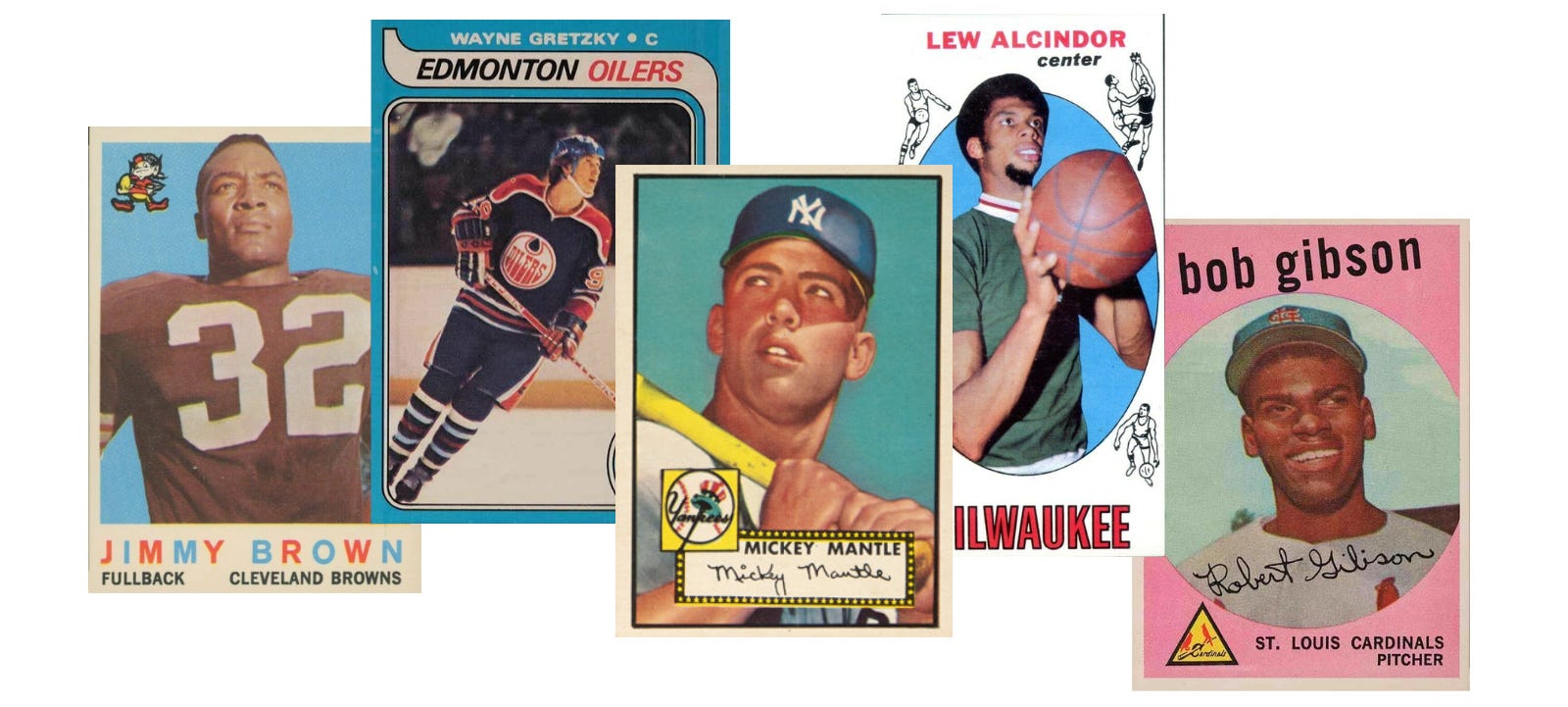
After the war, Topps and Bowman turned cards into a real product, and the hobby as we know it was born. The 1952 Topps Mickey Mantle is what everything else gets measured against. It’s also when the other sports show up for real, from the 1958 Topps Jim Brown on the gridiron to the 1979 O-Pee-Chee Wayne Gretzky on the ice.
In this era, the value isn’t locked up in the rookie card alone. A superstar’s whole run has meat on the bone. Jim Brown’s rookie is that ‘58 Topps, but his ‘59 second-year still pulls four figures in a clean grade.
Why? Nobody treated these like investments at the time. Kids jammed them in bike spokes. Moms tossed them out. Topps literally dumped cases of unsold 1952s into the Atlantic to clear the warehouse. So even a non-rookie of an all-time great is hard to find in nice shape. The scarcity blankets the whole era, not just one card per guy.
Junk Wax (1986–1994)
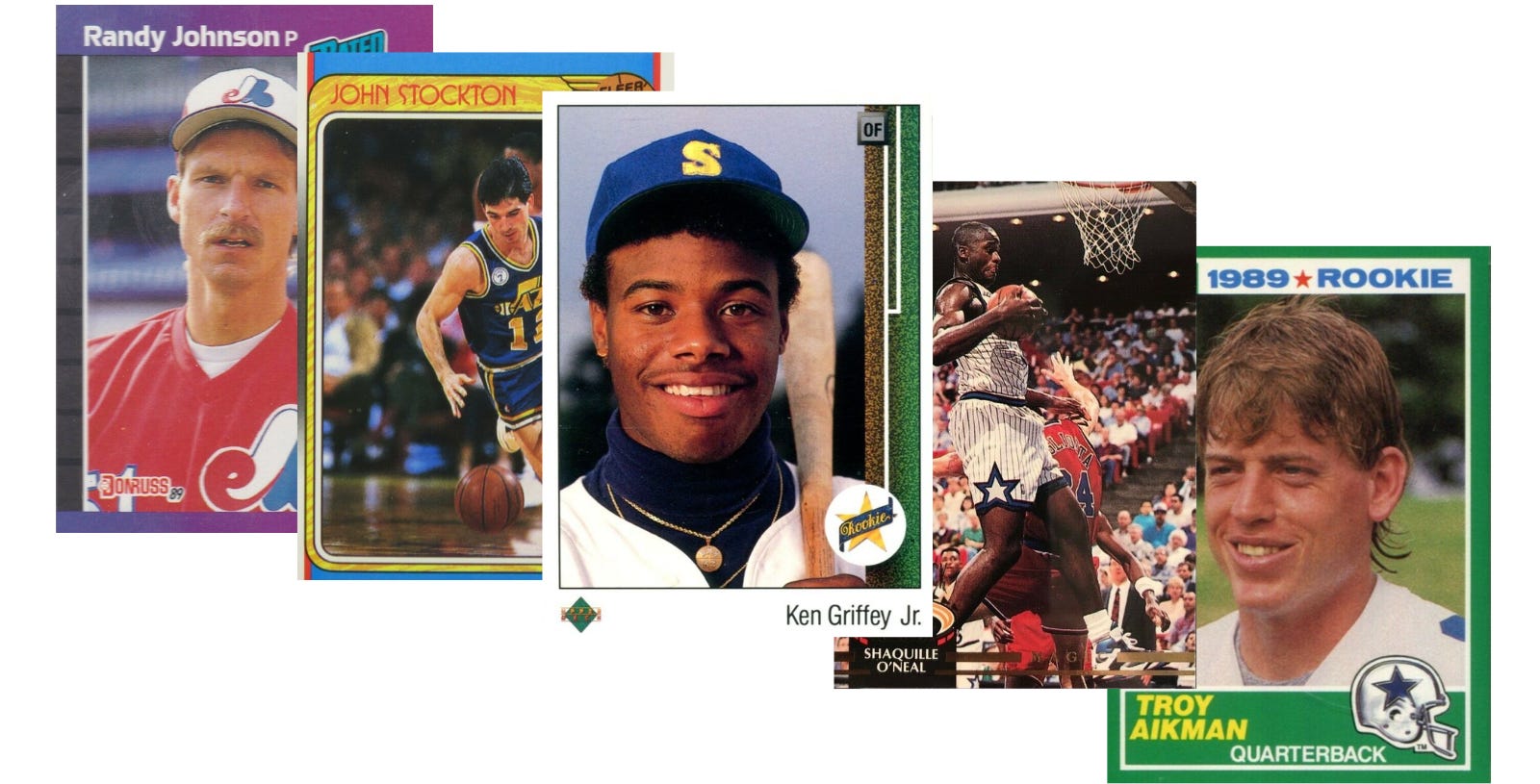
By the mid-80s, the Golden Era kids were grown up, with money to burn, back hunting the cards of their childhood. Demand went vertical. So the companies did the obvious, greedy thing. They printed. And printed. And printed some more. Some single cards from these years have print runs in the millions.
You can guess what that did. Base cards from this era are the punchline of the hobby. Too many of them. A complete 1990 Donruss set costs less than lunch.
But looking back, it wasn’t all worthless. Here’s what still has value today.
First, condition. They printed billions, but quality control was rough and nobody babied these cards. So any given card is common, while a flawless one isn’t. That’s why a junk wax card in a perfect PSA 10 can still bring real money. Scarcity snuck back in through the side door.
Second, and bigger, the inserts. The 90s were the wild west of insert design, and some were genuinely rare. This is where the grails hide. Shaq’s plain base rookie in a PSA 10 runs a couple hundred bucks. His 1992 Stadium Club Beam Team in the same grade? North of ten grand. Same player, same era.
There’s a shift here worth paying attention to.
In the Golden Era, a star’s whole run had value. Here, it has to be the rookie, or one of those rare inserts. A regular non-rookie of even a 1990 legend is dead weight. The natural scarcity that covered the Golden Era got steamrolled by the presses. Only the genuinely rare stuff made it out.
The survivors were the landmark rookies in top grades, the genuinely scarce inserts, and the few sets that dodged the overproduction, like 1986 Fleer Basketball. Everything else got left in the ten-cent bin.
Modern (1995–2010)
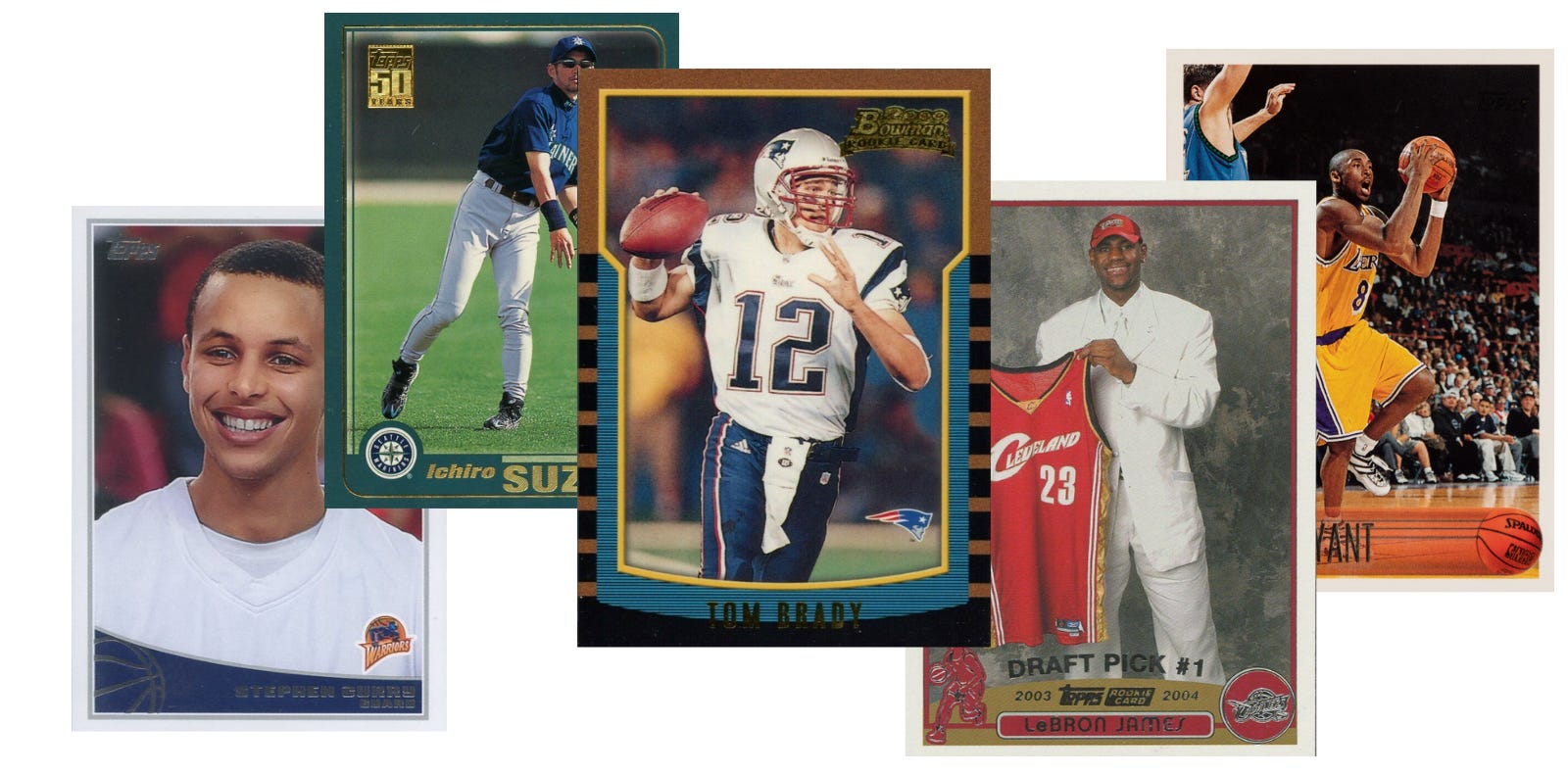
By the mid-90s, the companies learned their lesson.
Sort of.
Spooked by the crash, they needed scarcity back. But smaller print runs meant smaller profits, so rather than make less, they manufactured scarcity on purpose. This era handed us the whole modern toolkit: refractors, serial numbering, on-card autos, game-used relics, and later, the full rainbow of parallels.
The difference from what we see today was restraint. They made all the shiny stuff but kept print runs in check, so the scarcity was real. The grails prove it. The 1996 Topps Chrome Kobe. The 2003 Exquisite LeBron patch auto. The 2005 Crosby Young Guns. Rare by design, and actually kept rare.
Ultra-Modern (2011–2020)
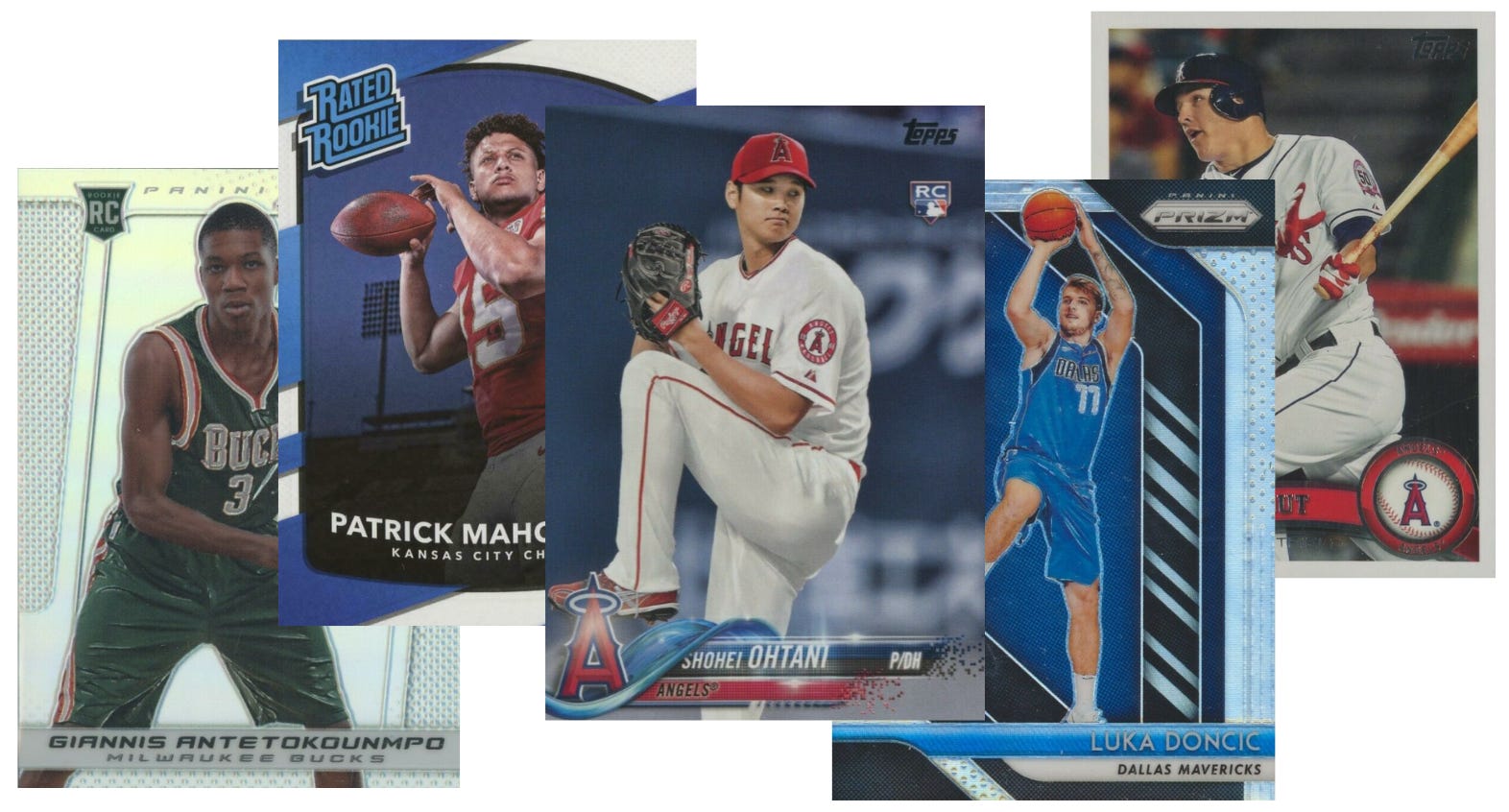
The last era where a base card could really matter.
Print runs were still reasonable. And a base rookie of the right player could carry real weight on its own. The classic example is the 2011 Topps Update Mike Trout, a plain paper base card that touched roughly $6,150 in a PSA 10 at its peak. Mahomes is another. His 2017 Donruss Optic base rookie still brings around $1,350 in a 10.
But base value here lives and dies with the player, and it can vanish. This is the first era where most of the careers aren’t over yet. A 1958 Jim Brown is a closed book, the price settled. These guys are still writing their stories, which makes a base card a live bet, not a final answer.
Look at Trout. From that $6,150 peak in 2020, his base rookie has slid to around $1,000 today. More than an 80% haircut. Nothing to do with print runs or parallels. He just got hurt, over and over, and lost the better part of five seasons. Mahomes went the other way and kept climbing. Both still active. The value can lurch either direction, because the games are still being played. Worth remembering before you go all in on any current player’s base.
Untitled Current Era (2021–present)
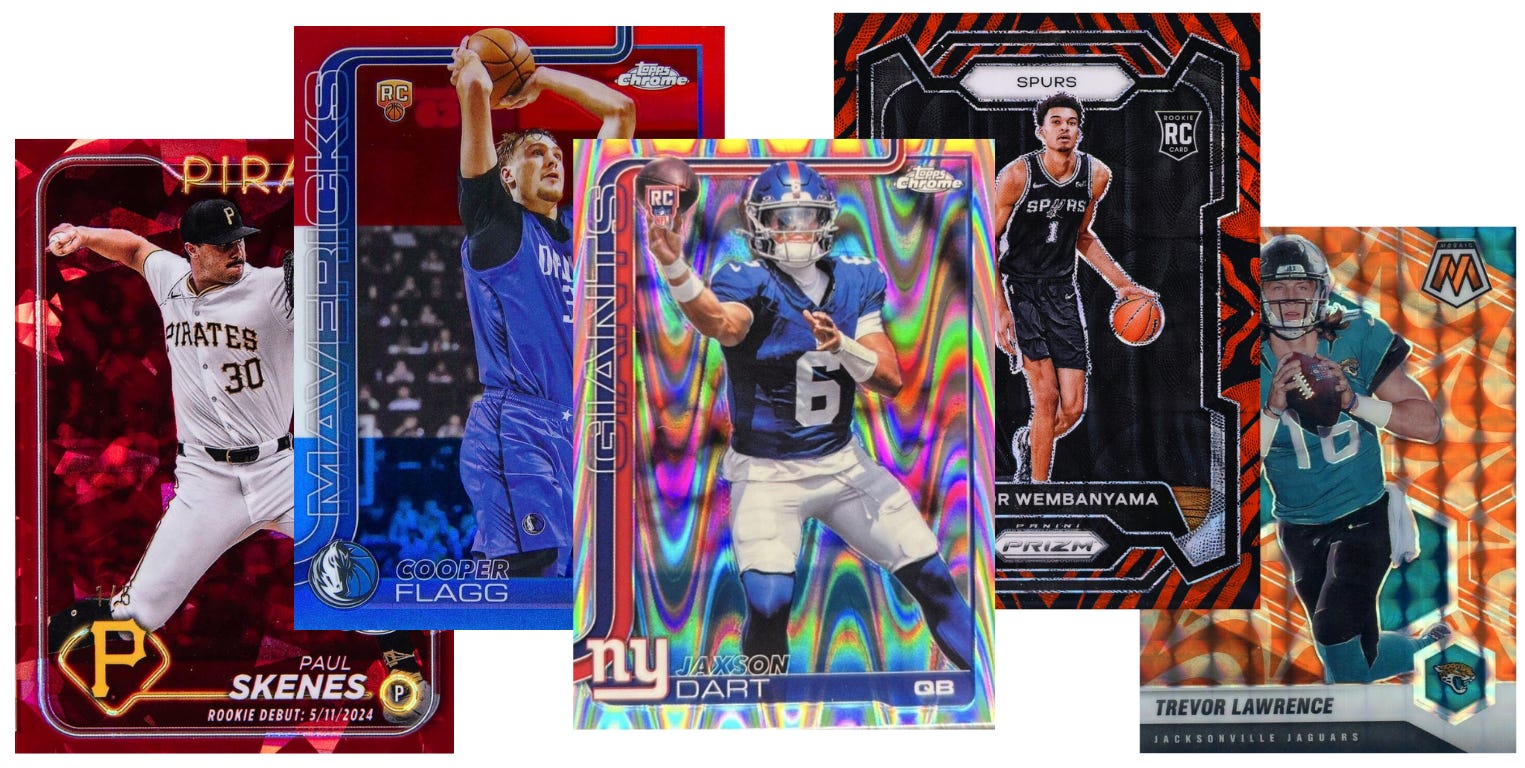
Which brings us to right now.
We’re not going to hand this era a name, because the hobby hasn’t agreed on one and it’s not our call. You’ll hear a few. Some say “junk slab,” a jab at how everyone grades everything now. Others go “The Fanatics Era,” after the company that scooped up most of the hobby. We’ve been calling it Junk Wax 2.0, strictly as a placeholder until something better sticks.
The name can wait. The symptoms can’t be missed.
The parallels have gone off the rails. We counted. Topps Chrome Baseball had around 18 types of parallels in 2020. Last year? 46. Not a typo.
The sister sets are multiplying too. The same base checklist gets reissued under a new name with a fresh rainbow bolted on. In 2022, Topps Chrome Sonic did exactly that, the whole set reprinted with its own parallel lineup. They never brought it back, but Logofractor Edition picked up the baton.
And the base sets keep swelling, from 220 cards to 300 in a couple of years.
So: more base cards, times more parallels, times more sister products. Three multipliers stacking up at once. If that smells familiar, it should. It’s exactly what buried the original junk wax era, just in a shinier suit.
So What Actually Survives This Time?
Step back and look at the whole walk, and one pattern jumps out.
In every era, the cards that held value shared two traits. Real scarcity, and a player people genuinely cared about. Neither does the job alone. A rare card of a nobody is still a nobody. A card everybody loves but everybody owns is still cheap. The only thing that changed was where the scarcity came from. Survival in the old days. Condition in junk wax. Disciplined design in the modern era.
And that’s the trouble now.
This era cranks out scarcity so hard the scarcity stops meaning anything. When a card has 46 parallels and a couple of sister sets, a copy numbered to 99 isn’t rare. It might not even be the only parallel numbered to 99 in the set. It’s one more option on the menu.
Here’s the lesson the 90s left us. The inserts that became grails, the PMGs and Beam Teams, didn’t just last because they were rare. They lasted because they were iconic and rarely repeated. The companies made them special, then walked away. Today does the opposite, running the same finishes, Lava and Raywave and Sonar, year after year across every product they can. The one thing that made the old chases valuable is the one thing this era refuses to do.
You can see it in a single line. Count up every type of parallel across a player’s rookie-year cards and the trend is impossible to miss. Kobe’s 1996 rookies had 13. LeBron’s 2003 had 88. Luka’s 2018 has 286. You’ll watch a kid pull a base Luka and look let down it didn’t come with color. A generational rookie, treated like a shrug.
So where does that leave us? Three calls.
Some Parallels Make It. Most Won’t.
The clean, low-numbered, good-looking parallels of real stars will hold. The endless parade of high-numbered novelty refractors won’t. We went deep on which ones collectors chase in an earlier article, so we won’t rehash it here.
The gist: clean designs, gold, low serial numbers, and team-color matches stand out. The rest is shimmer.
The Parallel Universe

Collectors from the ’80s and ’90s remember the Junk Wax Era all too well — when millions of cards flooded the market and even the greats became nearly worthless. To keep collectors interested, card companies needed something new. Cutting print runs meant losing profit, so instead, they got creative. Enter the
Base Cards Are Dead Weight. Paper Most of All.
The harsh one, and we’re not hedging. Some of these base cards exist in the millions. In normal condition, they’re worth nothing.
And the cruel part? The thing that rescued the original junk wax era, condition scarcity, isn’t coming this time. In 1990 nobody graded and quality was spotty, so gem copies stayed rare by accident. Now grading is an industry. PSA alone slabs millions of cards a year, and modern cards roll off the line clean. The PSA 10s won’t be scarce. The lifeboat that saved 1990 has a hole in the bottom.
Rookie Autos and Inserts Are the Real Keepers.
This is where your money and attention should go.
One comparison says it all. A standard Paul Skenes 2024 Topps Chrome Update rookie auto runs about $1,350 in a PSA 10. An Ichiro 2001 Topps Chrome rookie, just the base, goes for around $1,400 in the same grade. Sit with that.
A base autograph today holds about what a base rookie card did twenty-some years ago. The auto has become the new floor for a comparable star. The base card fell to the bottom, and the autograph took the spot it used to hold.
Inserts are trickier, and we’d rather be straight than fake a crystal ball. Nobody knows which insert sets people will be misty-eyed about in twenty years. The Beam Teams and PMGs of this era haven’t shown themselves yet, and anyone who swears they know is guessing.
So the smartest move is also the easiest. Collect the sets you actually like. There’s real logic there, not just a warm feeling. If a design grabs you, chances are it grabs other people too. Taste travels in packs. The cards you love already have an audience waiting, and that’s about as safe a bet as this era hands out.
And at the very top, the rules never bend. True one-of-ones and single-digit hits of players who actually pan out will always hold. The peak always survives. The hobby’s already arguing about which of today’s parallels is the next PMG. That argument is half the fun.
Where Do We Go From Here?
The hobby has done this before. The original junk wax era printed itself into a hole, watched the base cards crater, and learned years too late that the real value was hiding in the scarce stuff and the cards people loved.
Now it’s happening again. The base is going to be wallpaper. The rookie autos, the smartest parallels, and the inserts that actually win people over will be the survivors. And somewhere in this flood of shiny cardboard, a handful of cards are quietly becoming the grails of 2046, even if none of us can say which ones.
But here’s the part worth holding onto. Being in another junk wax era doesn’t mean you have to quit. We’re certainly not going to.
Overproduction doesn’t make ripping a pack any less fun, and it doesn’t make the card you love any less yours. It just means you collect a little smarter. “Collect what you love” isn’t a cop-out. It’s the one play that pays off no matter which way the value breaks. Buy the cards that make you want to keep collecting, and you’ve already won.
So we’ll kick it to you. Your guess is as good as ours.
What’s the next PMG? And which of today’s inserts are we still talking about in twenty years? Drop it in the comments. We read every one.
Disclaimer: The content in The Hobby Wire is for informational and entertainment purposes only. Commentary, analysis, and opinions on sports cards, rookies, and the hobby are not financial, investment, or professional advice. Collectors should always do their own research before buying, selling, or trading cards. Market values are volatile and can change rapidly—past performance is not a guarantee of future results.
Unless specified, all pricing references are based on the Prizm/Refractor parallels of an athlete’s Chrome rookie card, with prices from market movers, alt.xyz & 130pt.com.
Any odds mentioned were derived from DraftKings Sportsbook.
The quick history lesson helped out. I think I’m up to speed on sports cards now 😆