

Since the start of the 2025 MLB season, the question around the league was simple: if Juan Soto reset the market at $765 million, what does that mean for the next tier of elite position players? We thought we had a rough answer when Vladimir Guerrero Jr. landed $500 million over 14 years. Now, we have more clarity.
Last week, Tucker signed with everyone’s favorite villains, the Los Angeles Dodgers, for four years and $240 million. That’s a record setting $60 million a year!
We want to take this opportunity to really dig into what kind of player Kyle Tucker is. Is he worth such a high price point? What’s the outlook of his card market? Does going to the Dodgers help or hurt him?
Let’s take a look.
King Tuck
RF / Los Angeles Dodgers / Draft Info: Round 1, Pick 5 in 2015
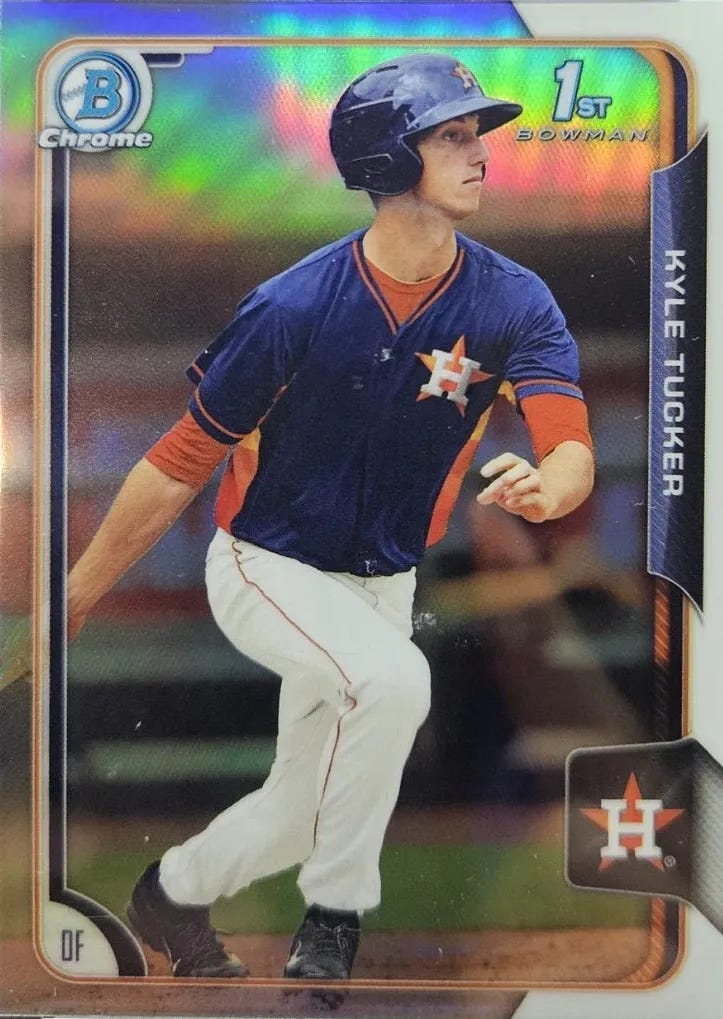
Kyle Tucker is not your typical superstar.
At the plate, he’s a disciplined left-handed hitter with elite bat-to-ball skills and above-average power that plays to all fields, pairing a patient approach with the ability to punish mistakes without selling out for pull-side juice. Tucker’s swing is compact and repeatable, which keeps his floor high even during down stretches, though his contact profile can skew ground-ball heavy at times, capping his home run totals relative to his raw power. On the bases, he’s a smart, opportunistic runner who adds sneaky value with steals, and in the field he’s a steady, plus defender in right with strong instincts and an accurate arm rather than highlight-reel flash.
He’s quiet, efficient, and relentlessly productive — traits that help teams win but don’t always move cardboard.
The knock is that Tucker is a jack of all trades and a master of none. Tucker does everything on the diamond very well. However, we’ve never seen him hit more than 30 dingers in a season, swipe more than 30 bags, and while he’s a great defender in the outfield, there are certainly better.
Tucker also is coming off of two seasons with substantial injuries. His final season with the Astros was cut short with a fractured shin and, while he played through it, it was revealed he had a hand fracture during the tail end of last season with the Cubs. We’d be more concerned if this were a pattern of soft-tissue injuries, but it’s still something collectors should note.
Do The Dodgers Help or Hurt?
Collectors know the hobby punishes great players in bad situations. Context matters. When we evaluate the ecosystem around a star, we’re looking at three things:
Coaching stability: Is there a system to grow in, or constant turnover?
Front office / ownership: Are they building winners, or making questionable moves?
Roster outlook: Is the supporting cast strong, or still in flux?
Time and time again, the Dodgers put a winning team in front of us. Sure they have money, but they also have one of the most skilled front offices and scouting departments in the league. They have one of the longest-tenured active managers in baseball with Dave Roberts and have made the postseason every year since 2013.
After winning it all in 2020, the front office got a taste and has made it their mission to collect as many rings as possible no matter the expense. They operate more like the early-2000s Yankees, and small-market fans absolutely hate it. Collectors, on the other hand, usually don’t. Every winter, another star seems to board the next flight to LAX. This year, it’s Tuck.
With Tucker joining the likes of Freddie Freeman, Shohei Ohtani and Mookie Betts, opposing pitchers won’t be able to pitch around him, meaning we should see an uptick in his batting stats.
GOAT Watch 🐐
At The Hobby Wire, we’ve never understood why unproven talent commands higher prices than the true legends of a sport. If a modern rookie auto is outselling the GOAT at their position, that should be your signal to cash out. Let’s see how Tucker performs up against one of the greatest five-tool outfielders in baseball, and hobby favorite, Ken Griffey Jr.
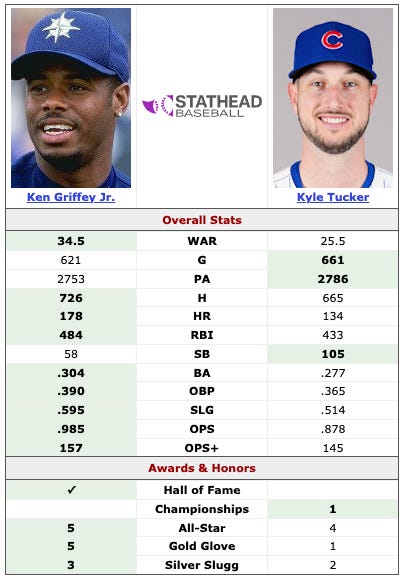
Tucker didn’t start playing full seasons in the MLB until 2021. So we compared his Seasons 4-8 stats to that of Griffey.
Statistically, it’s not particularly close. Tucker doubles The Kid in stolen bases, but Griffey clears him in nearly every other meaningful category. Ken Griffey Jr. is running laps around Tucker defensively, with five Gold Gloves compared to Tucker’s one.
The value here checks out. A signed rookie card of Griffey can cost upwards of $1,000. Tucker’s non-numbered autos hover around $200.
Career Projection
Kyle Tucker is just entering his prime as a professional baseball player. He’s been a consistent 5 WAR player since he started playing full time in 2021.
The average baseball superstar plays an average of 15-20 seasons. If Tucker remains this consistent, let’s see what kind of numbers he can put up throughout the course of his career.
*Based on Kyle Tucker’s performance through the 2025 MLB Season.
8 Seasons (Current Stats)
WAR 27.3 • Hits 748 • HR 147 • RBI 490 • SB 119
10 Seasons
WAR 37.5 • Hits 1,014 • HR 201 • RBI 663 • SB 161
15 Seasons
WAR 63.1 • Hits 1,679• HR 255 • RBI 1,096 • SB 266
20 Seasons
WAR 88.7 • Hits 2,344 • HR 389 • RBI 1,529 • SB 371
If Tucker plays for twenty seasons, the WAR stands out. If he finishes with 88.7 WAR, he’ll be just shy of top 30 all time, below Wade Boggs. That amount of WAR combined with the 300+ Home Runs and 300+ Stolen Bases should even be enough to get into the Hall of Fame. But while the résumé looks very good, those numbers aren’t going to put him in the baseball pantheon of all-time greats.
Hobby Heat Map
Here, we want to put our finger on the pulse of the hobby and get a sense on what collectors feel about King Tuck. To do this, we’re going to take a low-end rookie and a high-end rookie and track sales performance throughout his career.
Our Low-End Pick: 2019 Topps Chrome #39 Kyle Tucker Refractor PSA 10
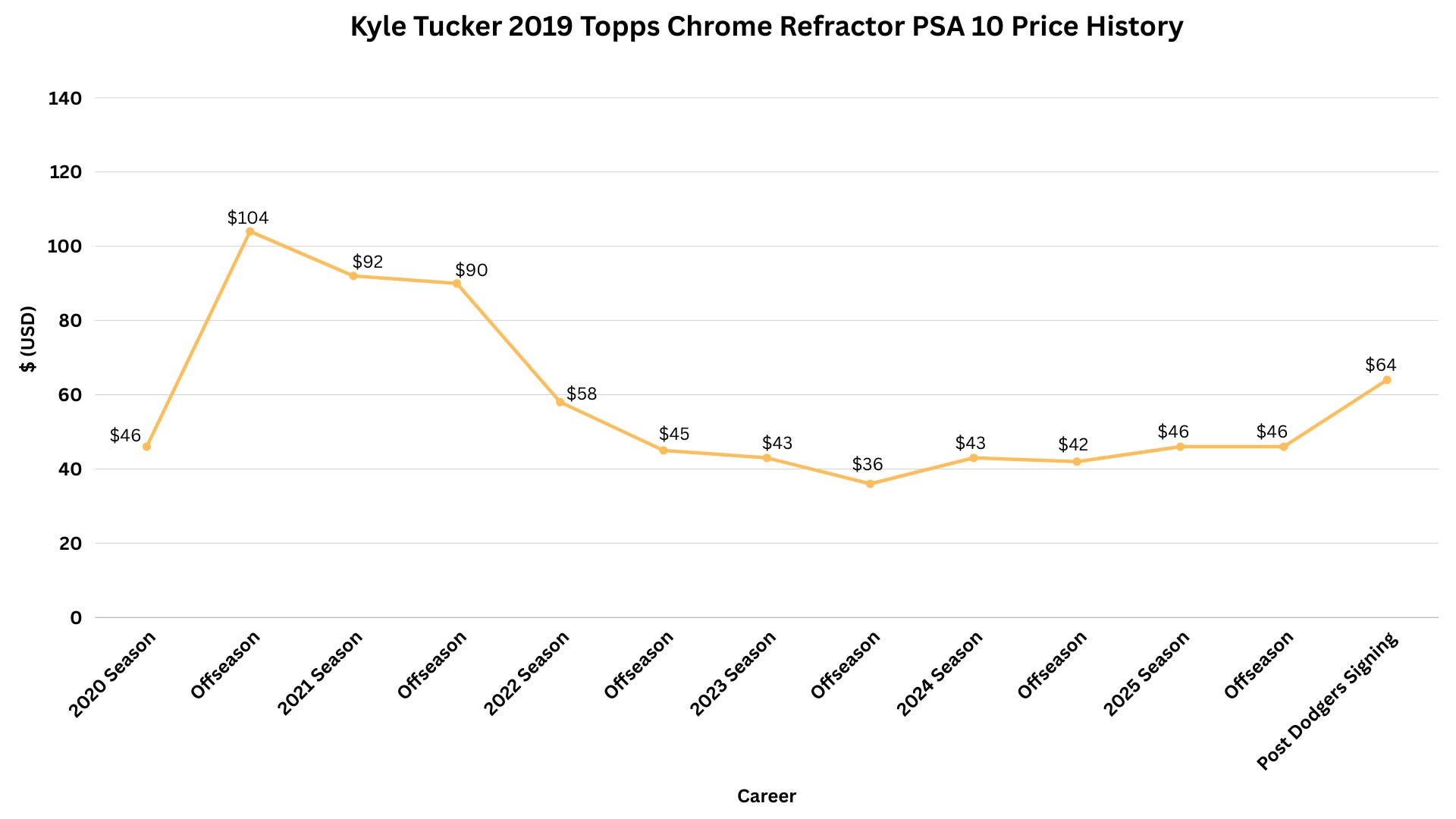
Tucker’s consistency appears to extend from the field directly into his card market. 2021 stimulus check market aside, the hobby really seems to like him in the $40-$50 range. However, since he signed with LA, his card prices have gone up nearly 40%.
Our High-End Pick:
2019 Topps Chrome Sapphire Kyle Tucker Orange Refractor Auto #KT PSA 10
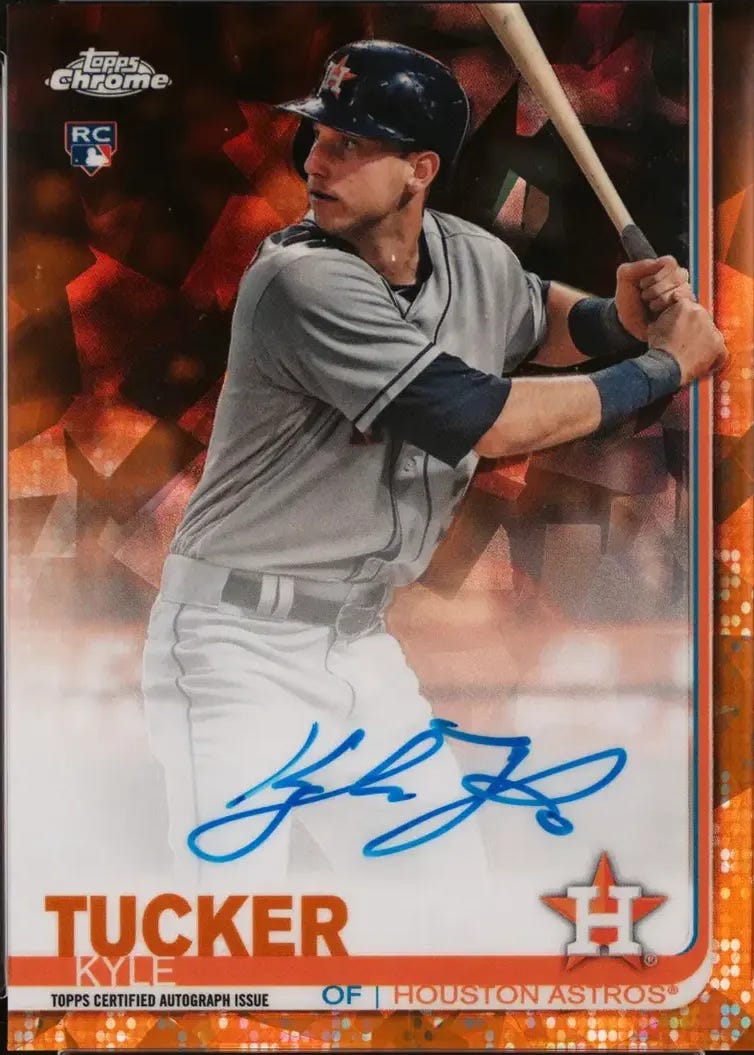
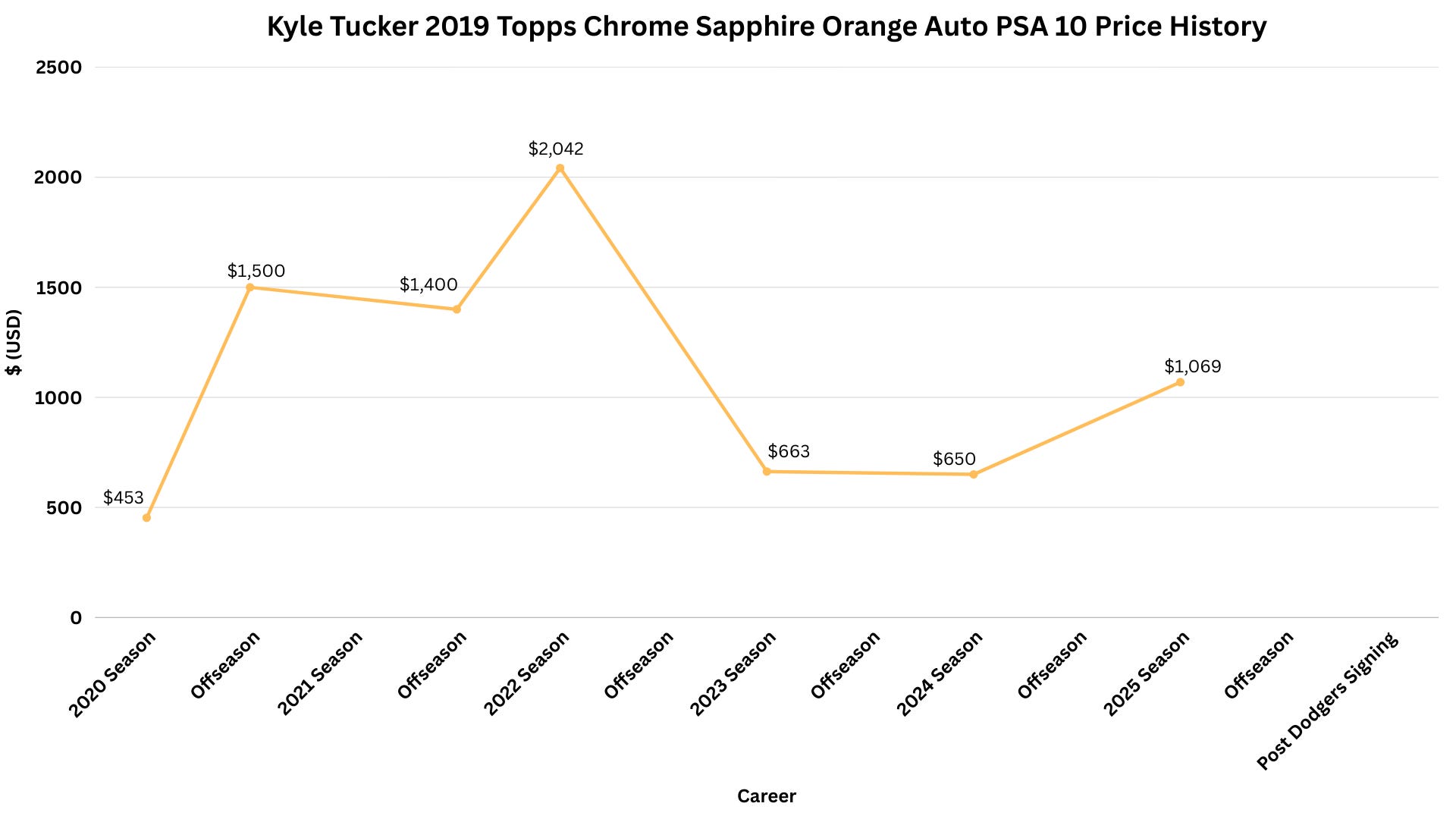
The high-end collectors and investors look more willing to gamble on Tucker becoming a true superstar and the face of a franchise. Where the low-end cards saw a dip during 2022, this card’s value went up as the Astros added another World Series title to their collection.
After 2022, the card dipped into the $650 range until someone decided to take a flyer on Tucker in his last season before free agency in 2025. While there hasn’t been any meaningful price action on this card so far this winter, if we assume the same 40% increase post Dodgers contract, this card is currently sitting around $1,500 again.
What’s His True Value?
Kyle Tucker’s still young. Not even 30. With his style of play not being the most athletically demanding, we think it’s very realistic to see him play another 10+ seasons.
Assuming he hits those 20 year benchmarks we’ve projected, he’ll be leaving MLB with a career close to that of Carlos Beltrán’s, with slightly more WAR.
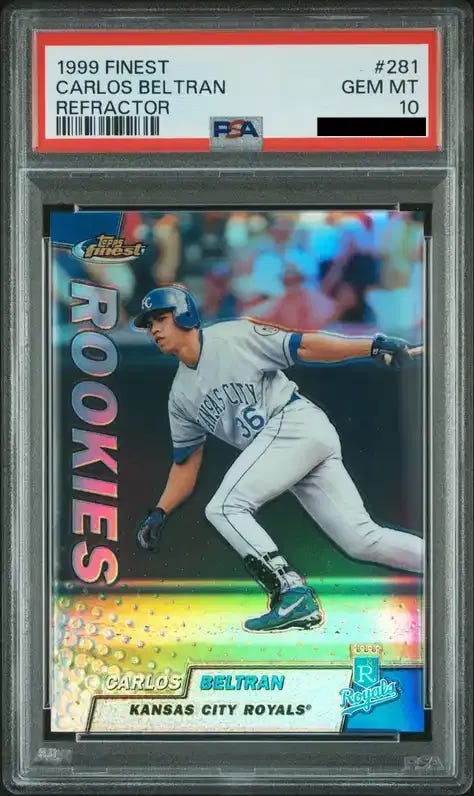
Beltrán’s 1999 Topps Finest Refractor rookie card currently sells for for $331 in a PSA 10. Tucker’s goes for $34.40. However, there are only 4 copies of Beltrán’s PSA 10 compared to the 30 copies of King Tuck.

When you adjust for population, the long-term value of Tucker’s comparable Topps Finest rookie pencils out closer to $45. Slightly north of what it’s going for in the secondary market right now.
Our Verdict
Kyle Tucker is the rare player whose value is clearer to front offices than it is to the hobby. The Dodgers paid for consistency, versatility, and a high floor that helps championships happen. Collectors, however, pay for dominance, star power, and the potential of a future legend. Tucker has yet to show a single defining trait that separates him from the pack.
That doesn’t make him anything less than a very, very good player. But from a hobby perspective, it’s fair to ask whether his cards have already reached their long-term peak.
Yes, there’s been a bump since he signed with baseball’s newest evil empire. And yes, the Dodgers’ lineup should boost his counting stats as pitchers are forced to challenge him. He may even build a Hall of Fame résumé over time. But being the fifth-best player on a stacked roster, paired with a low-key personality, doesn’t tend to create hobby darlings.
If you’re hunting for upside, the ceiling feels capped. For that reason, we’re passing on Tucker cards as a long-term investment.
For collectors who genuinely enjoy the player and want him in their PC, this is a perfectly reasonable entry point. His value looks fair, rational, and properly priced.
Sometimes the sharpest move isn’t chasing the next spike. It’s recognizing when the market has already gotten it right.
Disclaimer: The content in The Hobby Wire is for informational and entertainment purposes only. Commentary, analysis, and opinions on sports cards, rookies, and the hobby are not financial, investment, or professional advice. Collectors should always do their own research before buying, selling, or trading cards. Market values are volatile and can change rapidly—past performance is not a guarantee of future results.
Unless specified, all pricing references are based on the Prizm/Refractor parallels of an athlete’s Chrome rookie card, with prices from alt.xyz & 130pt.com.
Any odds mentioned were derived from DraftKings Sportsbook.