

A little over a year ago, we did something we’d never done before and sprung for a 2025 Bowman Hobby Box. We’d loosely been following Charlie Condon’s college career and thought we’d go in big on the product where his cards were the biggest chase.
Turns out, we made the right choice.
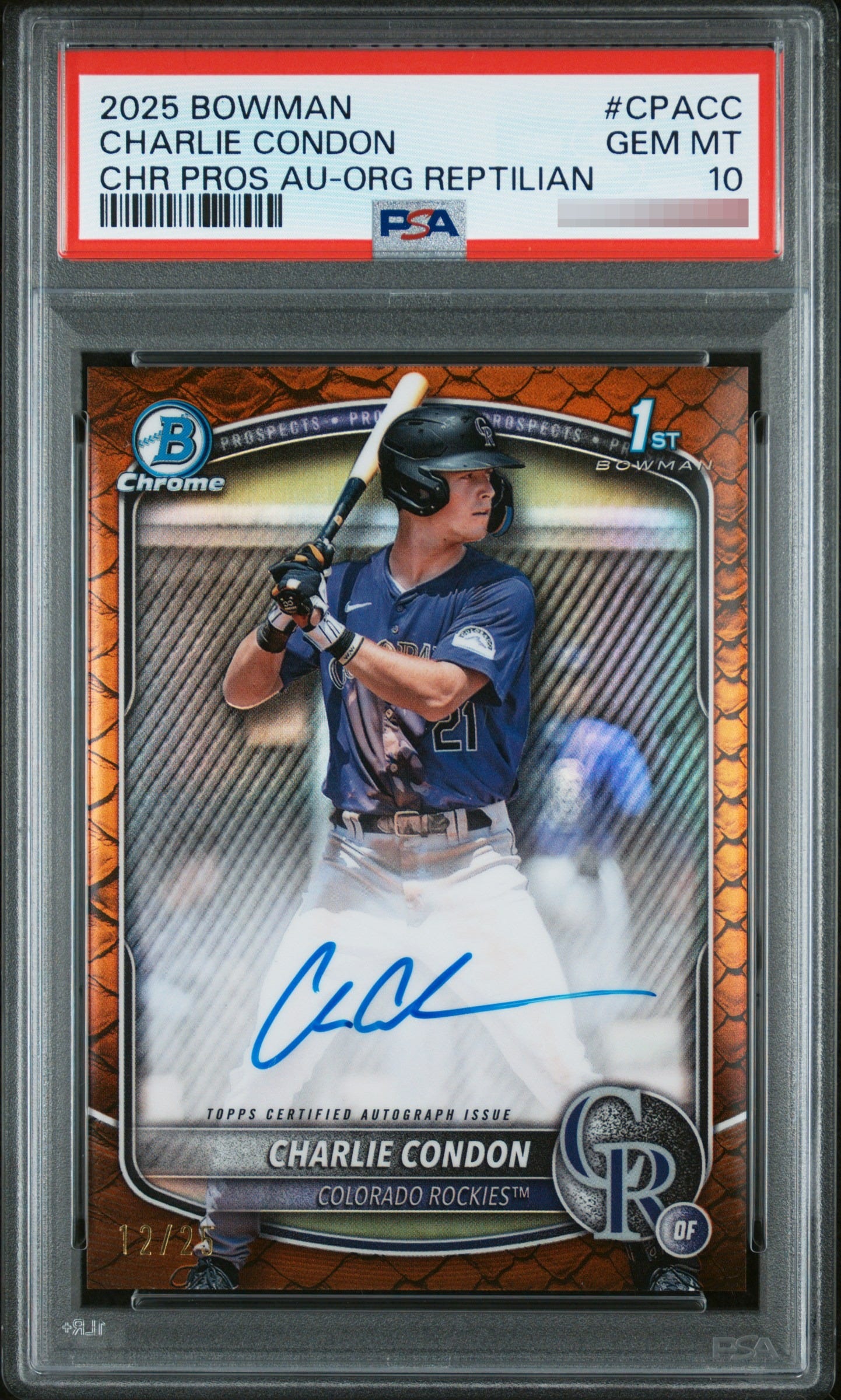
This Charlie Condon Orange Reptilian Auto barely saw the light of day before we put it in a semi-rigid and shipped it off to PSA.
Condon can absolutely mash a baseball. He did it in college, when he set the single-season Division I home run record for the BBCOR era, and he’s still doing it in AAA. The fact that he’ll be playing in Coors when he gets the call-up gives us a lot of optimism that he’ll live up to the hype.
We’re most likely going to look to flip it when we start hearing word of a call-up. But, with this being the only PSA 10 in existence, how are we supposed to comp it?
We’ve been down this road before. In our first installment of Under the Hammer, we had to comp our PSA 10 Black 2025 Topps Chrome Mickey Mouse SSP.
With that card, there was no sales history at all to go off of. So we used a rule we’d heard echo through the hobby ever since we got back into collecting in 2020.
“PSA 10s typically go for 2-3x the price of a raw copy”
Hammer price for that Mickey ended up at $1,647, right in line with the $700 raw comp we found for the Black Goofy, the closest stand-in we had. That’s 2.35x, sitting right inside the range.
It worked that time, but if that’s the general rule of comping, we’re going to need some proof to back it up.
Let’s rip in.
The Rumors
There are two rumors we’ve heard time and time again in this hobby. It doesn’t matter where we are, either. Be it at a card show or on the stream of a box break we bought into, lots of collectors are saying the same thing.
Myth #1: A PSA 10 is worth 2-3x the price of the raw card.
Myth #2: A PSA 9 is worth the same as the raw card.
A lot of people fall back on these when there’s no easy comp for the card they want to sell.
The Stress Test
We pulled comps for 100 cards, ranging from superstars to average Joes. Iconic sets to overprinted base. We comped each card using a 30-day average pulled from a combination of Market Movers and 130point.
Our samples spread across multiple eras of collecting. From the Golden Era, spanning the late ‘40s to the mid-’80s, all the way to the Ultra-Modern era of 2011 to today (or whatever you want to call it).
We intentionally left out Pre-War, as that’s a whole different animal when it comes to comping.
Myth #1: PSA 10 = 2-3x Raw
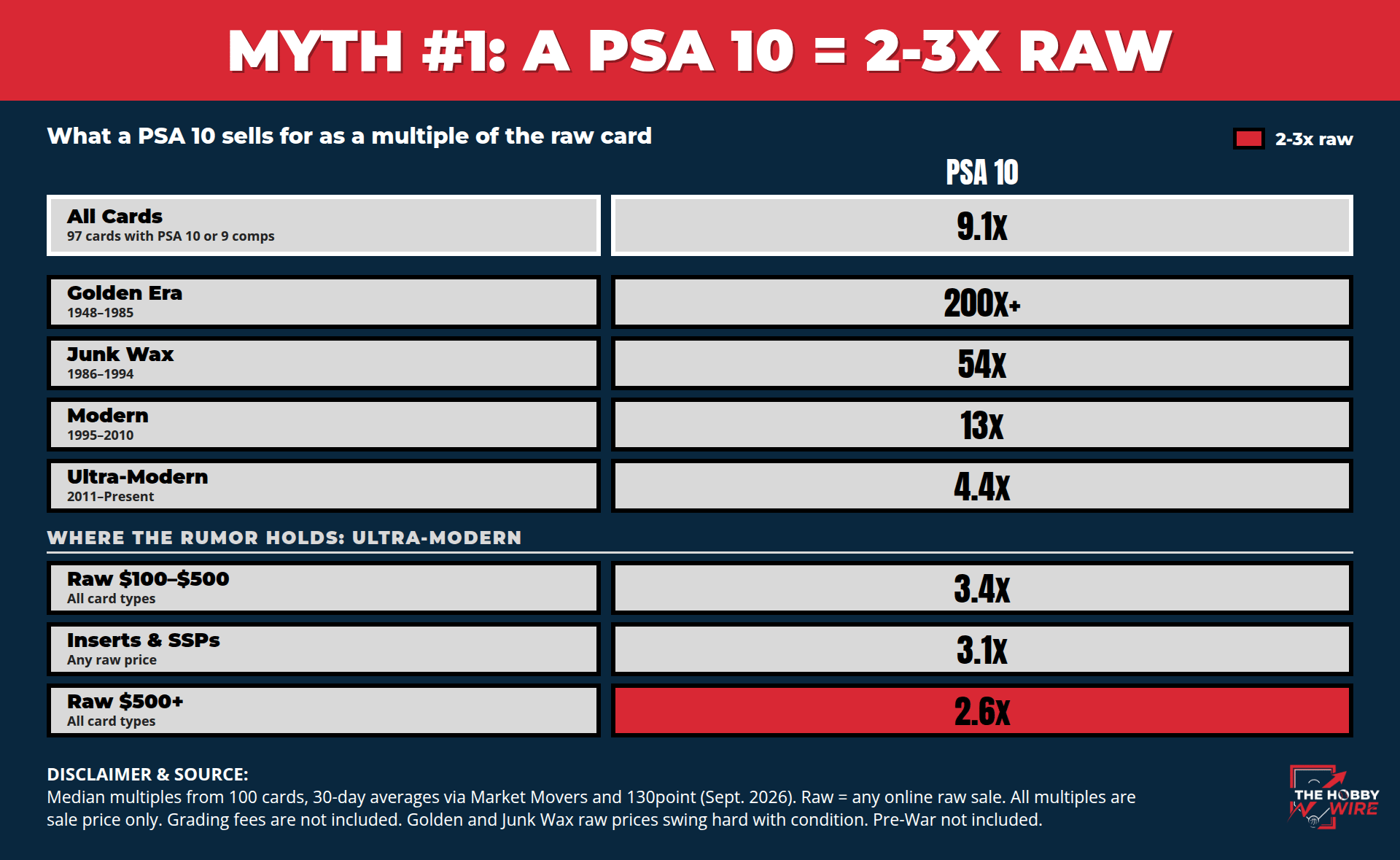
Saying a PSA 10 is worth 2-3x the price of a raw card just doesn’t hold up when you look across all cards.
If anything, the 2-3x rule is selling you short. The median multiple of our 100 sample cards came in at 9.1x. In fact, 84% of our cards cleared even the top of that range.
Breaking it down by era shows us that the older your card is, the more valuable a Gem Mint grade makes it. Good luck finding a raw Golden Era card that’ll grade a 10 these days, though. It’s that scarcity that does the real work in driving up prices.
But there is an area where we can see how this rumor may have started. Look specifically at Ultra-Modern cards (2011 to today), and the 2-3x rule is dead on for raw cards in both our $100 to $500 and $500+ tiers, as well as inserts and super short prints. We saw it play out firsthand with our Chrome Mickey. A $700 raw comp times 2.6 lands right in the ballpark of what we actually got for the card.
Seeing as how the hobby has become a culture of ripping a pack and immediately sending it away for grading, it’s no surprise that something specific to Ultra-Modern cards would stick as an unofficial hobby rule.
Verdict: Busted as an overall rule. Plausible for Ultra-Modern inserts, SSPs, and raw cards $100 and up.
Myth #2: PSA 9 = Raw
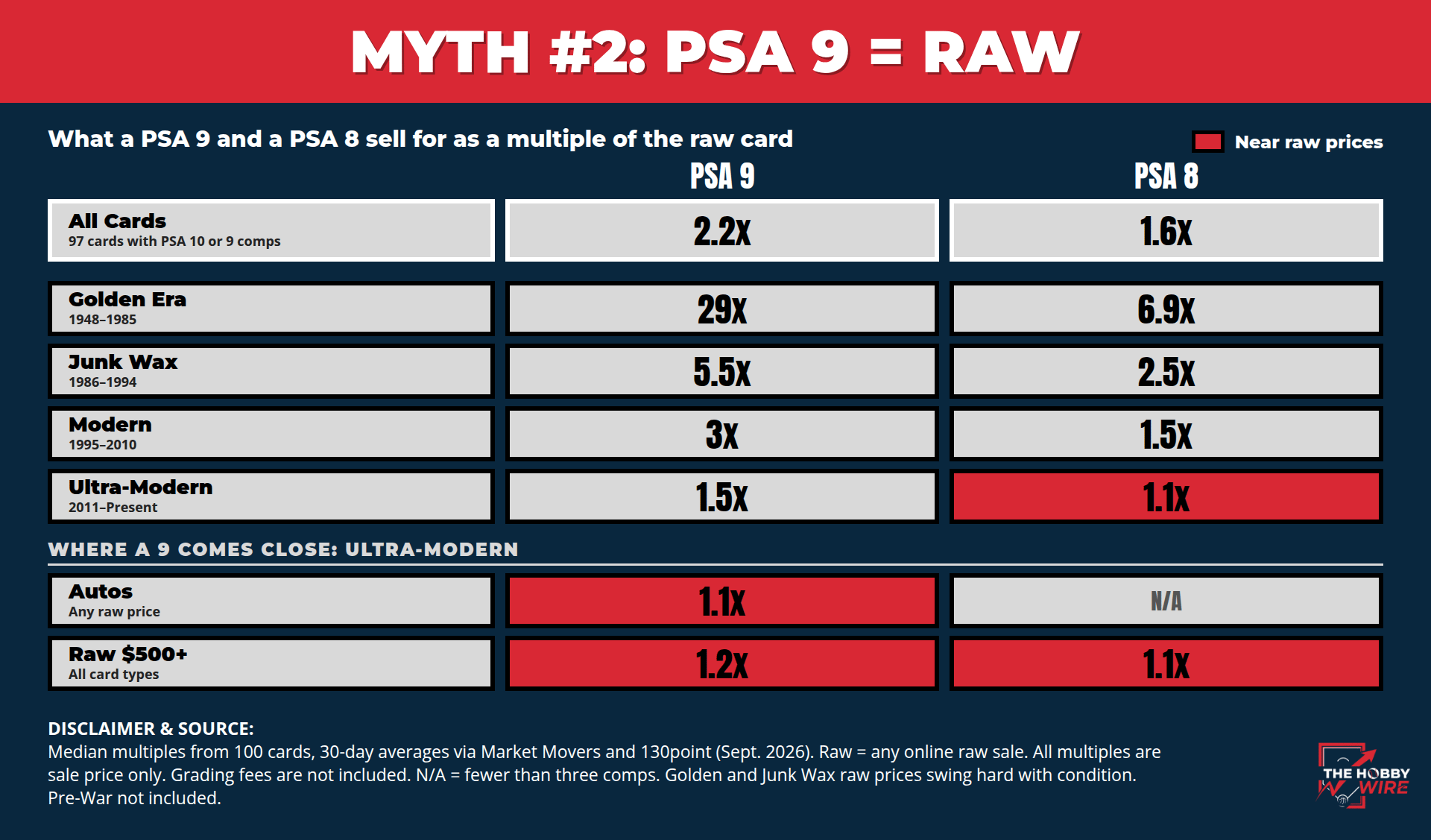
Once again, breaking it down by era makes it more complicated.
If you’ve got a Golden Era card that looks more than decent, send it in and you’ll likely make a profit. But for Junk Wax and Modern stuff, grading will only be worth it if you get a 9 or above. For Ultra-Modern, unless it comes back a 10, you’re more than likely losing money. An Ultra-Modern PSA 8 is actually what comes in closest to the raw value. 9s come in a little higher at 1.5x, which might be sellers baking the cost of grading into the sale.
Again, the rule proves true for specific corners of the Ultra-Modern market. Raw cards worth over $500 came in at 1.2x and autos at 1.1x, right on top of their raw counterparts.
There’s actually a bigger risk here than the chart shows. Of the cards we sampled, 47% were selling for less than the raw price plus the grading fee if they came back a 9. Nearly a coin flip on whether a 9 even makes your money back.
Verdict: Busted overall. Plausible for Ultra-Modern autos and cards worth over $500.
Other Findings & Cheat Sheets
The further we broke down our 100 sample comps, the more useful nuggets we found. If you're ever looking to comp something with limited data, these cheat sheets are where we'd start.
What Have We Learned?
Both rumors were busted as overall rules, but there’s still something to take away here. Between the two of them, the rules hold up on the types of Ultra-Modern cards most people are grading these days. Autos. SSPs. Cards worth over $500.
It makes a lot of sense why these “rules” are spreading around like gospel. They feel right. They’re easy to repeat. And the people repeating them are usually grading the one type of card where they actually hold up. Our SSP Mickey insert was a great example of this.
But, while we couldn’t find a universal rule book here, this wasn’t a total loss. Breaking our 100 sample cards down by era gave us a pretty good set of guidelines.
Remember, we’re following these guidelines as a way to set our expectations. The real price your cards sell for is truly out of your hands. Value is measured by what someone is willing to pay for it now. Not what someone paid for it three months ago. We aren’t looking to be precise here. We just want a way to catch ourselves when our gut feeling about a card’s value ends up way off base.
Using these cheat sheets, we have a pretty good idea of what our Condon Auto will sell for if we send it to auction today. When we get closer to his call-up, whenever that may be, we can run it again and realign our expectations.
What are some cards you’re looking to grade but are having trouble comping? Let us know in the comments.
Disclaimer: The content in The Hobby Wire is for informational and entertainment purposes only. Commentary, analysis, and opinions on sports cards, rookies, and the hobby are not financial, investment, or professional advice. Collectors should always do their own research before buying, selling, or trading cards. Market values are volatile and can change rapidly—past performance is not a guarantee of future results.
Unless specified, all pricing references are based on the Prizm/Refractor parallels of an athlete’s Chrome rookie card, with prices from market movers, alt.xyz & 130pt.com.
Any odds mentioned were derived from DraftKings Sportsbook.