

Welcome to Rookies Regraded — our series revisiting the draft classes that shaped the hobby. We look back to see which players became stars, how their markets evolved, and whether the wax still holds up. Each installment breaks down the class, the key rookies, and today’s wax landscape to deliver one verdict: rip, flip, or skip.
Draft night in Kansas City belonged to the quarterbacks. Three of them went inside the first four picks.
Three seasons is usually enough time for a card market to sort itself out. This one hasn’t moved much at all, and the gap between what this class was supposed to be and what it’s actually shaping up to be is wider than almost any class we’ve regraded.
So how does the 2023 NFL rookie crop stack up today?
Let’s rip in.
Snapshot — What We Thought Then
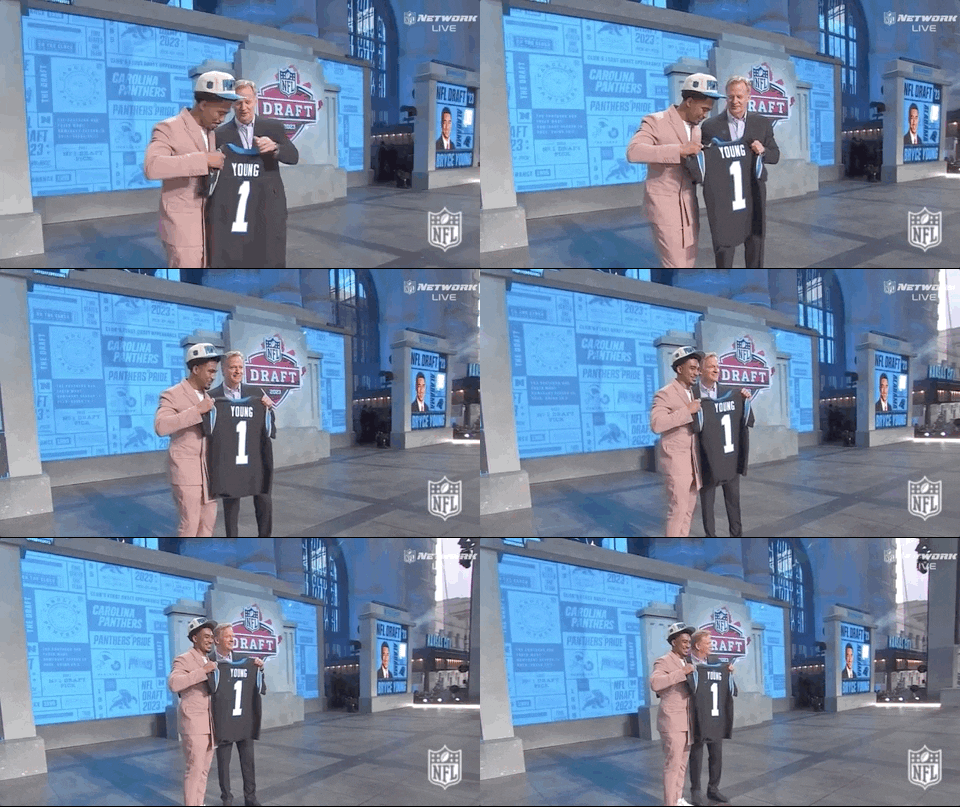
The quarterback room was the whole story. Four passers were positioned to go inside the top five, which made this cycle look stronger than the two before it, and PFF graded the group as legitimately strong with a passer worthy of the first overall pick. But the reporting kept circling back to the same caveat. All of them had flaws.
Bryce Young, QB, Alabama. The consensus QB1 on most final boards. Heisman winner, elite processor, best pure passer in the class. Evaluators had him as the most polished passer available. The 5’10”, 204-pound frame was the entire debate. Everything else was praise.
C.J. Stroud, QB, Ohio State. The rising alternative at 6’3”, 218, with prototypical size, underrated mobility and a big arm. He improved his stock as much as anyone from the Playoff game against Georgia through a stellar Combine. The knock was a low cognition score that leaked pre-draft.
Will Levis, QB, Kentucky. The prototype. 6’3”, 229, with elite arm strength and a compact release that let him drive the ball anywhere on the field. Josh Allen comparisons followed him all spring. The problem was the tape. He regressed as a senior behind a bad offensive line while playing through shoulder, foot and finger injuries, and his turnover-worthy throws nearly doubled his big-time throws. Most boards still had him top five anyway.
Will Anderson Jr., EDGE, Alabama. The safe blue-chipper. Highest floor in the class, no off-field concerns, searing explosiveness and lateral agility. One of the few true blue chips on the board.
Jalen Carter, DT, Georgia. Highest ceiling, highest risk. A rare 3-technique at 6’3”, 310 who could wreck a game against the run or the pass. He arrived attached to legal trouble and a poor pro day, and teams had to decide how much capital they were willing to put on it.
Anthony Richardson, QB, Florida. The lottery ticket. Historic Combine athleticism, 13 career college starts, wildly inconsistent accuracy. About as raw as a first-round quarterback gets. Whoever drafted him was signing up to wait.
Bijan Robinson, RB, Texas. The most exciting non-quarterback. Widely considered generational, the best back since Barkley, and by some accounts the best athlete in the draft. The only real debate was positional value. How early is too early for a generational running back?
From the outside, the reviews got cold quickly. ESPN’s Matt Miller called it a weaker class overall, stocked with older players who’d been delayed by COVID opt-out years. CBS was blunter, framing 2023 as a real drop-off in top-tier talent.
No consensus number one. A top-heavy quarterback draft attached to a class scouts openly called mediocre.
So were they right?
