

Card breaking has been part of this hobby long before the internet. Walk into any card shop in the country and you might find collectors cracking boxes together, chasing hits, and splitting the cost of a box or a case.
What’s changed is the scale. Platforms like Whatnot have taken something that happened at a folding table in a hobby shop and turned it into an $8 billion-a-year business. With that scale has come scrutiny.
A legal fight is now brewing that could reshape how the entire industry operates. Here’s what’s happening, why it matters, and what we’re watching.
What’s Actually Going On
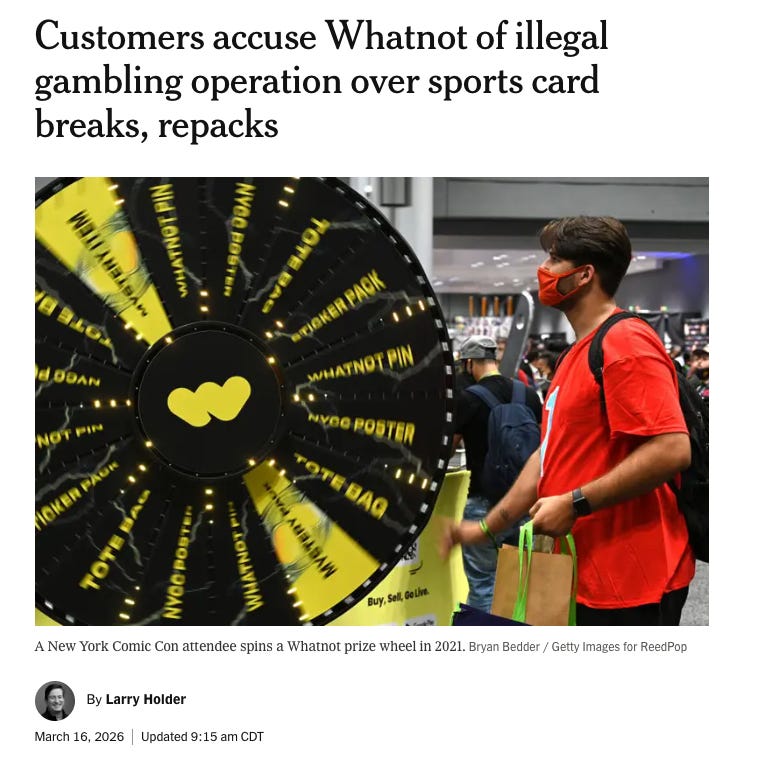
Attorney Paul Lesko has filed 15 arbitration demands representing 30 clients (with more expected) against Whatnot. The claims allege that the platform’s randomized box breaks and repack breaks violate the RICO Act, California’s ban on illegal lotteries, and the state’s specific prohibition on sports trading card “grab bag” lotteries.
The complaints don’t characterize Whatnot as a marketplace. They call it an “unregulated online casino.”
The core argument isn’t subtle: when you pay for a spot and a wheel spin or dice roll determines what you receive, you’re not shopping. You’re gambling.
The plaintiffs also allege that some repack formats went further than lottery mechanics. Outright fraud, through shill bidding and sellers tipping off favored buyers about where the high-value cards were located.
Whatnot has “absolutely rejected” those characterizations.
Their defense rests on three points:
Breaking is a long-standing hobby tradition
Their platform sets the industry standard for live transparency
Breakers make up only 4% of total sellers. Whatnot argues most of what it does is traditional commerce.
The stakes are significant. Whatnot reported $8 billion in sales in 2024, double their 2023 numbers. Sports cards are their top category, with over 6.4 million cards changing hands every month. This isn’t a small fight.
What is Arbitration?
Before we get into what happens next, it’s worth understanding what kind of fight this actually is. Because it’s not the kind most people picture when they hear “lawsuit.”
Most major platforms, Whatnot included, bury a mandatory arbitration clause in their Terms of Service. When you click agree, you waive your right to sue in public court. Any dispute goes through a private arbitration process instead: a neutral third party, a binding decision, almost no path to appeal. Traditionally, that’s been a big win for companies. It’s a lot harder for one person’s $500 claim to do real damage than a $50 million class action.
There’s a loophole, though. And lawyers figured it out.
Instead of one class action, Lesko is filing dozens of individual arbitration demands at once. Many arbitration agreements require the company to pay filing fees, often $1,500 to $3,000 per case. File 30 simultaneously and you’ve handed Whatnot a bill approaching $100,000 just to show up. Scale that to hundreds of cases, which Lesko has signaled is the plan, and you’ve turned the company’s own legal shield into a financial weapon.
If Collectors Win: The Hobby Grows Up

Let’s say the arbitrators rule against Whatnot. What does that look like for us?
This could be the regulatory reckoning many in the hobby have seen coming since the 2020 boom. A ruling that randomized breaks and repacks constitute illegal gambling wouldn’t just affect Whatnot. It would force a fundamental restructuring of how modern cards are sold.
Age Verification Gets Real
Platforms like Whatnot, Fanatics Live, and eBay would likely be required to implement KYC (”Know Your Customer”) protocols similar to what sportsbooks use. Users in states with strict anti-gambling laws could be geofenced out entirely.
Odds Disclosures Become Mandatory
Breakers might be legally required to publish the exact probability of hitting specific cards in a repack, the same standard Fanatics and Topps already have to meet when releasing new sealed product.
Breaking Shifts Format
It wouldn’t disappear. But we’d likely see far more Pick Your Team and Pick Your Player breaks, formats that sidestep the lottery definition entirely.
The High-End Market Feels It
Breaking currently drives a significant volume of high-end sealed product. Without breakers absorbing $2,000+ boxes of National Treasures and Prizm, manufacturers would face real pressure to justify those price points.
This wouldn’t be a market crash. It would be a maturation. The hobby being asked to follow the same rules as the gaming and sports betting industries it’s been quietly resembling for years.
If Whatnot Wins: The Wild West Gets Wilder

Now let’s flip it. Whatnot successfully defends its model. What happens then?
It wouldn’t just be a win for one platform. It would be a green light for the current state of the hobby to continue, and likely accelerate.
The “Entertainment” Shield Solidifies
A Whatnot win would validate the argument that breaking is “interactive entertainment,” not gambling. If an arbitrator rules that what’s being sold is the live experience and the card is secondary, that framing becomes a legal template every platform in the industry can use. Terms of Service across the board would get updated with even more explicit “show over prize” language. The argument would have been stress-tested. It held.
The Floodgates Open
Right now, eBay and Fanatics have been slightly more cautious with randomized mystery formats than Whatnot. A Whatnot win changes that calculus overnight. Wheel spins, high-low games, and bounty formats go from experimental features to standard fixtures. Manufacturers might even launch their own “official” repack products to capture the margins that individual sellers currently pocket.
The Government Wild Card
Here’s what a Whatnot win doesn’t resolve: the government.
Private arbitration is a contract dispute. A state Attorney General investigation is a law enforcement action, and Whatnot’s mandatory arbitration clause can’t touch it. If these 30 cases fail, the attorneys involved can take their evidence directly to the California or New York AG’s office and argue public nuisance or consumer protection violations. Both states have aggressive consumer protection regimes. Neither is bound by anything in Whatnot’s Terms of Service.
Winning in arbitration closes the private fight. It doesn’t lock the door on a government action.
How Will We Know?
Because of the privacy arbitration provides, don't expect a headline that reads "Whatnot Loses." But the hobby has a way of turning private legal battles into very public market signals. Here's what we're watching.
A Terms of Service Pivot
This is the clearest tell. If Whatnot starts losing cases, or the mass arbitration filing fees become too expensive to absorb, the platform will quietly update its Terms of Service. Watch for sudden bans on randomized formats or new requirements for "probability-verified" software. When a company printing $8 billion a year changes its rules overnight to restrict a profitable feature, something moved behind the scenes.
The Petition to Confirm
Arbitration is private. Enforcement often isn't. If Whatnot refuses to pay an award, or if the plaintiffs want to convert a win into a legally binding judgment, they have to file a Petition to Confirm Arbitration Award in public court. That's where the results hit daylight. Once it's in a court filing, it's public record.
The Bellwether Signal
In mass arbitration, lawyers typically run a few representative "bellwether" cases first as a test run. Even if final settlements are confidential, lead attorneys usually signal a win one way or another. A simultaneous settlement across all 30 claimants would likely surface as a joint press release, or a platform policy change that tells the whole story without saying it directly.
Where We Stand
Group breaks can be fun. We recognize that. But we also recognize what they actually are: collectors putting money down and hoping to receive something worth more than what they bought in with. That’s gambling. It might be gambling wrapped in a live stream and a community chat, but the underlying mechanic is the same.
Every other form of gambling in this country operates under regulation. Sportsbooks verify your age. State lotteries publish their odds. Daily fantasy platforms spent years fighting for licensing approvals on a state-by-state basis before they could operate legally.
The question worth asking isn’t whether breaking feels different from those things. It’s why it’s been treated differently by the law for this long.
These 30 arbitration cases might be the moment that question gets a formal answer.
Have thoughts on the Whatnot cases? Breaking on the platform yourself? Drop your take in the comments.
Disclaimer: The content in The Hobby Wire is for informational and entertainment purposes only. Commentary, analysis, and opinions on sports cards, rookies, and the hobby are not financial, investment, or professional advice. Collectors should always do their own research before buying, selling, or trading cards. Market values are volatile and can change rapidly—past performance is not a guarantee of future results.
Unless specified, all pricing references are based on the Prizm/Refractor parallels of an athlete's Chrome rookie card, with prices from Market Movers, alt.xyz & 130pt.com.
Any odds mentioned were derived from DraftKings Sportsbook.